- Empty cart.
- Continue Shopping
An Enchanting Despot
5 cast members · Comedy
An Enchanting Despot
An Enchanting Despot · Peter Harrison
1 / 1
An Enchanting Despot
Published by scriptsandsketches.com

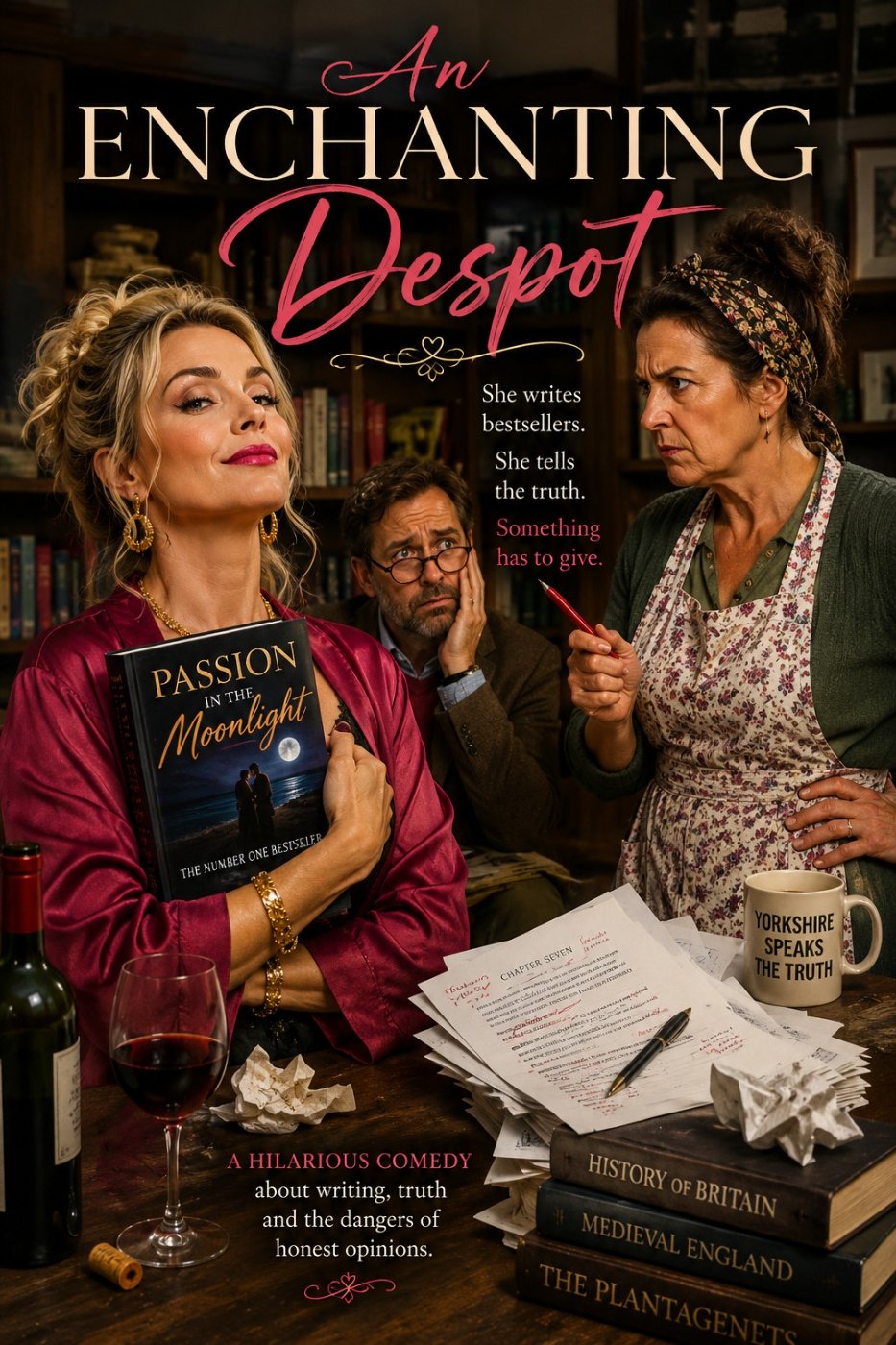
Sally, a bestselling novelist, and her historian husband Andrew navigate the chaos of their contrasting literary worlds, spiced up by their outspoken Yorkshire home help.
Group
Characters: SALLY, ANDREW, ROSE, ZOË, PATRICK
Husband and wife authors Sally and Andrew write about very different subjects in their rustic kitchen.
SALLY:
(shouting offstage) Andrew!
(calling stage left) Andrew!
(calling stage left) Andrew!
ANDREW:
(calling) Just a minute.
SALLY:
Andrew, will you please come when I summon you?
ANDREW:
For Heaven's sake, Sally. What is it? I've got work to do as well, you know.
SALLY:
I don't know anything of the sort.
ANDREW:
So what was it?
SALLY:
I have an urgent spelling request.
ANDREW:
You also have a dictionary.
SALLY:
How do you spell troilism?
ANDREW:
What?
SALLY:
Troilism. How do you spell it?
ANDREW:
Is that all you wanted? Couldn't it wait? It's hardly an emergency.
SALLY:
Andrew, whatever I require, whenever I require it, a red rose in the middle of the night, in the middle of winter as you lie dying, is, by definition, an emergency. Troilism. I'm doing a spell check on Chapter Seven. And troilism isn't in.
ANDREW:
I’m not surprised. Might I suggest you use the dictionary?
SALLY:
I can't be bothered. Anyway if I can't spell it how can I look it up? (Pause)
So?
So?
ANDREW:
What?
SALLY:
Come on Andrew. Troilism. I've got a deadline.
ANDREW:
T-r-o-i-l-i-s-m.
SALLY:
And more importantly, does it mean what I think it means?
ANDREW:
I don't see how you can use a word without knowing what it means.
SALLY:
Most of the words I use are pure guesswork. Does troilism mean three in a bed?
ANDREW:
Yes. Sort of. Is that it?
SALLY:
No, there's one other thing before you go.
ANDREW:
Oh, really, Sally.
SALLY:
- Impotence.
ANDREW:
What about it?
SALLY:
It's the plotline I'm working on for my next chapter.
ANDREW:
Impotence, on the face of it, would appear to be opposed to everything you ... er ... stand for.
SALLY:
First we have impotence. The despair. The heartache. The recriminations. The anguished figure of our hero, perched on the edge of the bed, in the moonlight, with, in the absence of anything else to hold, his head in his hands. And then divine intervention. A miracle cure. According to the publisher’s computer a plot line involving impotence and then a course of Viagra would help to put on readers. What I want to know from you, Andrew, as a man, is how would you feel if you suddenly discovered your sexual powers were waning, and then you found they had been miraculously restored?
ANDREW:
(Diffidently) You mean in theory?
SALLY:
Andrew, may I be frank?
ANDREW:
Er... yes.
SALLY:
Open and honest?
ANDREW:
Which usually means offensive.
SALLY:
I mean what is a marriage without total frankness? You wouldn't really describe yourself as ... obscenely lustful, would you?
ANDREW:
Er ...
SALLY:
You are not a man whose whole life is controlled and dominated by the desire to fling down and ravish every single woman he meets?
ANDREW:
Er, not every single one, no.
SALLY:
In you, it has to be said, the desires of the flesh are firmly under control. But suppose you had in fact been leading a life of continuous sexual arousal? Leaving women sighing in your wake? Strewn languorously about the landscape. An endless succession of deeply grateful and satisfyingly sleepy female admirers?
ANDREW:
I think I would find the prospect rather worrying.
SALLY:
And suppose you then found that overnight those sighs of delight had turned into sighs of disappointment?
ANDREW:
Actually, I would probably feel quite relieved.
SALLY:
Unlike Mario. Mario Vercelli. Heir to the Vercelli fashion fortune.
ANDREW:
Sounds more like a pasta.
SALLY:
Count Mario Vercelli, a stylish and witty seducer in a double-breasted navy blue yachting blazer, with gold buttons, yellow trousers and highly polished black loafers, now living the life of an English country gentleman, in order to be able to indulge his passion for polo. And now, alas, through no fault of his own, seduction is out of the question. Once he had access to every gorgeous model in Milan and not surprisingly he could do it all night. That's what Italians are for. Obsessed, the poor darlings. But now worry about the business has left him feeling ... deflated. Hence, an opening, so to speak, has been created, for a rival. And then, at what one might call his lowest point, the Count begins a secret course of Viagra. I'm trying to describe how he would feel. As things started coming up rosy again, as one might say.
ANDREW:
Well, I really don't think I can help with that particular line of research. I'm sorry. Now, may I get back to my own modest exertions? … And by the way, you do remember, don't you, that Ms. Handel Williams is starting tomorrow?
SALLY:
Well, I’m afraid I’m booked for lunch. So you will have to greet her.
ANDREW:
Really, Sal. I did tell you.
SALLY:
Sorry. And I have to say I still think it's a very odd name. Did you ask her about it?
ANDREW:
It seems that Ms. Rose Handel Williams hales from Huddersfield where there is a proud tradition of choral singing.
SALLY:
Where is Huddersfield? In England? I don’t think I’ve heard of it.
ANDREW:
It’s in Yorkshire.
SALLY:
Huddersfield. In Yorkshire. How exotic.
ANDREW:
Where they especially love singing Messiah. By Handel.
SALLY:
The Messiah. Isn't that the one about what’s - his- name?
ANDREW:
The same.
SALLY:
And what about the Rose? Couldn't we go one step further and call her Rosie?
ANDREW:
I think not. Even after one meeting it was very clear that she is not a Rosie.
SALLY:
What a pity. The name does go beautifully with the house. Pure Cotswolds.
ANDREW:
Ms Handel Williams has a certain gravitas. No one, I would suggest, has ever dared to call her Rosie.
ROSE:
I'll be getting off now, Mr. Elliot.
ANDREW:
Ah, yes. Well, thank you... Rose. Everything looks very nice and tidy. Thank you. I think, we think, the arrangement is going to work very well.
ROSE:
Like I said, I'll try to be out of the kitchen by twelve, to give Mrs. Elliot enough time to get in and prepare your lunch.
ANDREW:
I'm afraid Mrs. Elliot and I don't have that sort of marriage, Rose. We tend to do our own thing at lunchtime. My wife gnaws fitfully on a stick of celery, or something equally undemanding. And I tend to pop down to the pub.
ROSE:
Every day?
ANDREW:
Most days.
ROSE:
That's no good. It’s not healthy. How would you like me to do you a nice omelette before I go? A Spanish omelette, perhaps.
ANDREW:
A Spanish omelette? Ah, well, no really I can't possibly put you to the trouble.
ROSE:
Mr. Elliot.
ANDREW:
Ah, yes, Rose?
ROSE:
Since it's my first day can we get something sorted?
ANDREW:
Er. Yes. Of course. Please. By all means.
ROSE:
Can we dispense with these no doubt delightful little civilities of life? I come from Yorkshire, as you know, where rudeness as a social skill is widely practiced. And one which I'm often accused of. So do you want a Spanish omelette? It's really a very simple question. If you do I'm happy to do you one. If you don't I'm off.
ANDREW:
What a simply lovely idea. A Spanish omelette, eh?
ROSE:
(Ominously) Well?
ANDREW:
(Firmly) Yes. Most definitely.
ROSE:
With a bit of salad?
ANDREW:
Yes. Yes, indeed. How kind. (Pause)
ROSE:
Mr. Elliot, can I ask you something?
ANDREW:
Er, yes. Of course.
ROSE:
When do you suppose I'm going to get to meet the distaff side of this household?
ANDREW:
The what?
ROSE:
Distaff. A cleft stick about three feet long on which wool or flax was wound for spinning by hand. A word which has now come to indicate woman's work. Therefore distaff side -- the female side of a family. Your wife. Mrs. Elliot. Will I run into her again, do you suppose? Perhaps on the stairs. Or rushing through the door. At some point?
ANDREW:
Oh, absolutely. You must. It's just that she is so terribly busy just now. (He laughs) I practically have to make an appointment myself.
ROSE:
But what about you? Surely you're busy as well.
ANDREW:
Well, not quite so busy, perhaps.
ROSE:
The bookshelf in your study. The Kieran the Archer books. I am right, aren't I?
ANDREW:
About what?
ROSE:
You are Paul Jones?
ANDREW:
Right in one. Paul Jones is my pseudonym.
ROSE:
Kieran the Irish mercenary. Those marvellous descriptions of ancient warfare.
ANDREW:
You know the books?
ROSE:
History is my passion. To be honest. In fact I never read modern books. Except for Laurie Lee, of course.
ANDREW:
Why Laurie Lee?
ROSE:
Cider with Rosie. Years ago when I was younger and dafter it was the book which brought me down here to Gloucestershire. And then I found that life down here was no longer a rustic idyll. There'd been a revolution. The aristocrats had risen up and overthrown the peasants. (Andrew laughs)
ANDREW:
Assisted by quite a few writers, I have to say.
ROSE:
Exactly. And between you, if you don't mind me saying, you've pretty well ruined it. If Laurie Lee's any guide. But, like I say, a friend recommended your books. And I've devoured them all. They may be fiction-
ANDREW:
- 'fraid so-
ROSE:
- but I think they're . .. masterly.
ANDREW:
Masterly, eh? Really? Ah ...
ROSE:
I mean it took a bit of guts taking on the Dark Ages.
ANDREW:
Why do you say that?
ROSE:
One of the most bloodthirsty times in history and I imagine almost totally unknown. Hence the description. But what you do is bring it all alive. The empty landscape. The vast forests. The unlit dark. The cold, the hunger and fear. And brooding over everything the ruins of the lost Roman civilisation. Do you know, there's one mental picture that's stayed with me ever since I read your description of it?
ANDREW:
(Delighted) Really? Tell me.
ROSE:
Do you remember your description of pigs rooting about among the ruins of a Roman villa, scattering and destroying the stones of a Roman mosaic floor? What a picture. And you didn't get that from your research. That's your imagination, is that.
ANDREW:
Really? Well, I ... er... I don't know what to say.
ROSE:
Why do you have to say anything?
ANDREW:
Well, I suppose I'm not used to such ... enthusiasm. But they don't enjoy huge sales, I'm afraid. Sally is the real success story in this household.
ROSE:
That's a matter of opinion. She writes dirty books, I believe.
ANDREW:
Well, er, I suppose parts of them are a little dirty.
ROSE:
And the other parts?
ANDREW:
Ah, shopping, mainly. Or so I believe.
ROSE:
You don't read them?
ANDREW:
Er, no.
ROSE:
I think you're very wise. Does she read yours?
ANDREW:
No. Actually.
ROSE:
I see. (Pause) Well, I would suggest you're a bit of an acquired taste. More for the discerning few. I would say. (Pause) And now for your omelette – before I manage to talk my way into getting the sack for insubordination.
ROSE:
I'm getting off now, Mr. Elliot. That all right?
ANDREW:
Yes, thank you, Rose. And thanks for preparing my bacon sandwich. I really do appreciate it. Above and beyond the call of duty, though, you know.
ROSE:
Have you thought of asking your wife to do you one? You never know your luck. Now you see. There I go. Rude again. I can't seem to help myself.
ANDREW:
(Laughing) Don't worry about it. It's rather refreshing.
ROSE:
Anyway, there's a favour I’d like to ask of you in return.
ANDREW:
Of course.
ROSE:
You can let me borrow your Palgrave.
ANDREW:
My? ... oh, The Golden Treasury. Borrow it? Of course. But -
ROSE:
- Mine has disappeared. I can't think where. I must have lent it to someone and they never gave it back. I hate it when people do that.
ANDREW:
Well, of course borrow it for as long as you like. To my regret it's some time since I dipped into it myself.
ROSE:
It's so annoying. There was a poem I wanted to look up and for some odd reason it doesn't feature in any of my other anthologies.
ANDREW:
You know, these days one doesn't often hear someone discussing poetry.
ROSE:
You mean, the daily help?
ANDREW:
That is not what I mean, Rose. And you know it.
ROSE:
Ah, well, I used to be a teacher.
ANDREW:
Really?
ROSE:
I thought I'd let it slip. You know - my shady past.
ANDREW:
No. I don't believe you did.
ROSE:
And old habits die hard. Learning poems by heart.
ANDREW:
What sort of a teacher?
ROSE:
Primary school. In the days before the classroom became an adventure playground.
ANDREW:
So when did you leave teaching?
ROSE:
When my daughter, Daisy, was born. I thought I would concentrate on bringing her up and by the time I was ready to return teaching had changed and left me behind.
ANDREW:
You have a daughter?
ROSE:
Oh, didn't I mention her either?
ANDREW:
I don't believe you did.
ROSE:
And before you ask, I haven't been married either. (Pause) Anyway, by the time I was ready to go back whole-class teaching had been replaced by rapturous little groups weighing sand and measuring sticks, with teachers wandering among them from time to time, and introducing themselves to the children if it had been a long time since their last visit. (Andrew starts to laugh)
By the Sixties reading had become something you picked up as you went along. Handwriting didn’t matter. Exercise books no longer had the tables printed on the back. And mental arithmetic was regarded as mental cruelty.
By the Sixties reading had become something you picked up as you went along. Handwriting didn’t matter. Exercise books no longer had the tables printed on the back. And mental arithmetic was regarded as mental cruelty.
ANDREW:
I have something to impart.
SALLY:
As in tell?
ANDREW:
Did you know that Rose had a child?
SALLY:
A child. What sort of a child?
ANDREW:
A daughter.
SALLY:
Black. White. A baby? A toddler? Or a teenage harpie?
ANDREW:
I didn't ask.
SALLY:
So she's had sex, then?
ANDREW:
I think we must assume she has, yes.
SALLY:
Well, what sort of a spinster is that?
ANDREW:
And there’s another thing - Rose used to be a teacher.
SALLY:
I knew there was something sinister about her.
ANDREW:
Primary school.
SALLY:
Well, that ought to rule out the child being the result of an affair with a pupil. But these days you can never be sure.
ANDREW:
So you really are going to have to watch your step.
SALLY:
Why?
ANDREW:
Because she specialized in teaching English.
SALLY:
I knew it. She wants to mark my books.
ANDREW:
What I mean is that you really are going to have to watch your spelling when you're leaving little notes out. Spell ‘receive’.
SALLY:
What?
ANDREW:
Before our last daily departed under something of a cloud you left her a note reminding her that you hadn't yet received her references.
SALLY:
Well?
ANDREW:
The rule is 'i' before 'e', except after 'c'.
SALLY:
Well, nobody told me.
ANDREW:
I am simply recommending that you check in the dictionary before you leave notes for Ms. Handel Williams.
SALLY:
Andrew, may I remind you of something? I may have been a misfit at school. In fact, I know I was. It isn't every girl who has to stand there during morning assembly, looking round and observing all the other girls down on their knees praying for her. And thanks I suppose to my basic inability to do anything more worthwhile I spend my time writing books. Which despite my involvement seem to zoom into the best seller lists, within a few days of publication, and stay there for a minimum of twenty weeks at the last count, before going into paper back and repeating the feat. An achievement - and I don't mean to be rude - which some rather more intellectually demanding authors don't appear to be able to emulate.
ANDREW:
Ouch.
SALLY:
So, I don't suppose our Rosie is in any position to criticise.
ANDREW:
Absolutely true. Except where spelling and grammar are concerned. And there, I fear she may just have the edge on you. And anyway, I just hope you don't say anything to upset her before Saturday’s supper party.
SALLY:
Would I?
ANDREW:
It was very good of her to volunteer to cook for us -
SALLY:
- For money.
ANDREW:
Rose never mentioned money. You did. In fact, she was clearly a bit embarrassed.
SALLY:
I doubt that. Offended, maybe. But not embarrassed. Not Rose.
SALLY:
Hello, Rose. Is it alright if I come in?
ROSE:
Well, it's your kitchen.
SALLY:
I suppose it is, really. But it's nearly lunchtime and if you're preparing something succulent for Andrew don't let me interrupt.
ROSE:
He's gone to the pub. He's meeting someone.
SALLY:
Are you sure now?
ROSE:
That he's gone to the pub?
SALLY:
That I can come in?
ROSE:
Like I say, it's your kitchen.
SALLY:
Well, you never know. Two women in one kitchen and all that.
ROSE:
It doesn’t bother me who comes in. Would you like me to fix you something?
SALLY:
Ah …
ROSE:
What can I get you?
SALLY:
Well, I rather fancied a tomato sandwich. But I'd prefer to see if I can get the hang of it myself. (Pause)
Andrew tells me you used to be a teacher, Rose. You should have warned us.
Andrew tells me you used to be a teacher, Rose. You should have warned us.
ROSE:
Warned you? What about?
SALLY:
You should have warned us and then we'd have been on our best behaviour.
ROSE:
People always think that.
SALLY:
What?
ROSE:
It's a bit like vicars. People always think teachers and vicars have higher standards.
SALLY:
Don't they?
ROSE:
I don't know about vicars but if you're a teacher you can sense it. You can sense yourself making people feel uncomfortable.
SALLY:
But I suppose you having a child does make you seem a lot more human. (Pause)
ROSE:
Mr. Elliot told you?
SALLY:
I do wish you'd told me, Rose.
ROSE:
Why?
SALLY:
Well, you know.
ROSE:
No, I don’t
SALLY:
Girl talk. That sort of thing. It would have been nice to think you would confide in me.
ROSE:
You make it sound like a guilty secret.
SALLY:
Now that isn't what I meant. You know Rose you really can be pretty sharp at times.
ROSE:
I know. People are always telling me.
SALLY:
Andrew tells me you're a great admirer of his work.
ROSE:
That's right.
SALLY:
But not mine?
ROSE:
No.
SALLY:
Andrew also tells me you've read all his books.
ROSE:
I think your husband is very talented. (Pause)
SALLY:
So, why don't you like my stuff?
ROSE:
You want the truth?
SALLY:
Er, I’m not sure. I think I do.
ROSE:
I think they're rubbish. And I also think you think so, too. To be honest.
SALLY:
Oh, please, do be honest. But well-written rubbish. Don't you think? (Rose laughs despite herself)
ROSE:
I really couldn't say. I haven't read any.
SALLY:
But the study's full of them. Don't you think you ought to try one. See if you like it. Like oysters?
ROSE:
Mrs. Elliot, you write dirty books. Shagging and shopping, I believe they're called. That's fine if you like that sort of thing. But while people are reading them, they're not reading the real thing. Which is a pity.
SALLY:
Oh. I see. (Pause, then brightly)
Rose, can I ask you something?
Rose, can I ask you something?
ROSE:
Of course. (For a moment Sally ponders the wisdom of her question)
SALLY:
You don't like my books. But what about me?
ROSE:
What about you?
SALLY:
Oh, you know. I sometimes get that rather odd feeling you sometimes get, usually with two women, the weirdest feeling that perhaps war has been declared but no one has actually declared it? Do you know the feeling?
ROSE:
Oh, yes.
SALLY:
You do?
ROSE:
I used to get it all the time with head teachers.
SALLY:
And do you have it now?
ROSE:
No, I don't think so. (Pause) No. Definitely not. As a matter of fact, if war had been declared I rather think you would know about it. Head teachers always did. And I wouldn't still be here.
SALLY:
Oh, good.
ROSE:
Believe me, I harbour no secret feelings of hostility - except to the sort of books you write.
SALLY:
Well, that's a relief.
SALLY:
Ten thousand three hundred and forty one. ZOË: (Peals of laughter) What have I said?
Are you sure it isn't ten thousand three hundred and forty two by now? ZOË: Well, the publicity girls get excited and call me every day.
Are you sure it isn't ten thousand three hundred and forty two by now? ZOË: Well, the publicity girls get excited and call me every day.
PATRICK:
I bet Andrew doesn't know how many copies he's sold. ZOË: Andrew?
ANDREW:
The latest book? Oh, just over six hundred at the last count. Sally's books rush out of Waterstones in hordes. Mine sort of saunter out. Alone.
SALLY:
But please don't feel sorry for Andrew. According to Rose, his books are literature which will endure for all time and could well end up winning the Nobel prize.
ANDREW:
Hardly likely, I fear.
SALLY:
And mine are barely literate. I mean, really. It isn't as though I don't tackle serious issues. Take Storm Warning, for instance. You could argue that it's also about the social acceptability of oral sex. And it’s sold thousands. ZOË: Word of mouth, you might say. (ROSE enters to clear up) ZOË: That was lovely, Rose. Really delicious.
ROSE:
Not my idea, I'm afraid. Mrs. Elliot cut it out. From a magazine. And it seemed to work. Shall I serve the pudding now? Or would you like to wait? ZOË: Rose?
Yes? ZOË: Mrs. Elliot is hurt because you don't read her books.
Is she now? ZOË: She thinks you think Andrew's books are ... worthier.
Yes? ZOË: Mrs. Elliot is hurt because you don't read her books.
Is she now? ZOË: She thinks you think Andrew's books are ... worthier.
PATRICK:
Oh come on Zoë. ZOË: What?
Stop stirring things. ZOË: I'm not stirring things. We are having a literary discussion.
Stop stirring things. ZOË: I'm not stirring things. We are having a literary discussion.
SALLY:
She is right, though, isn't she Rose?
ROSE:
She is. ZOË: And you're not a bit offended, are you, darling?
SALLY:
People always know instinctively when I'm offended, Zoë. As you well know.
ANDREW:
I really don't think it's fair to ... ah... put Rose on the spot like this.
PATRICK:
Exactly.
ANDREW:
I mean look at my sales. It's obvious lots of people can't stand my stuff.
ROSE:
That's hardly the point, though, is it? (Pause)
SALLY:
It isn't? ZOË: (Innocently) What is the point, Rose?
PATRICK:
(Warningly) Zoë. Behave.
ROSE:
Well, since you ask, the point is that Mr. Elliot .. believes in his writing. ZOË: And Sally’s writing?
Nobody believes in it. Especially not Mrs. Elliot, I suspect.
Nobody believes in it. Especially not Mrs. Elliot, I suspect.
SALLY:
I really feel I ought to issue a public warning here. To the effect that I could not be described as one of those who welcomes criticism.
PATRICK:
Look, can we please change the subject?
ROSE:
I think perhaps I'd better just get on with serving the pudding. I'm putting my foot in it, here. Again. ZOË: Absolutely not. Come on, Rose. Why are Andrew's books better than Sally's? (Pause)
In my opinion if you can write, you're someone special. I used to think, I could. And then I realised the truth. I knew what good writing was. But I couldn't do it. Mrs. Elliot can write. There is no doubt about that. ZOË: There you are, darling.
In my opinion if you can write, you're someone special. I used to think, I could. And then I realised the truth. I knew what good writing was. But I couldn't do it. Mrs. Elliot can write. There is no doubt about that. ZOË: There you are, darling.
SALLY:
I had the vague feeling that was a compliment but now I'm not sure. ZOË: (Innocently) Oh, do go on, Rose. This is very interesting.
ROSE:
You have to understand, I'm not just picking on Mrs. Elliot. It's she and all the other writers who are producing these beach books. These chick-lit sagas. They are just not … real. If you ask me, writing clever rubbish is worse than not being able to write at all. ZOË: (To Sally) Oh, dear, darling.
Look at the great women writers.
Look at the great women writers.
SALLY:
But please, I beg you, exclude me.
PATRICK:
(Stoutly) Not necessarily.
ROSE:
They all try to tell us what it's like to be a woman. Jane Austen. The Bronte sisters - Emily, Charlotte, Anne. Elizabeth Gaskell. George Elliot. And not just them - not just the immortals. I mean what you might term minor writers from the second division. Women like Elizabeth Bowen, Muriel Spark, Winifred Holtby. Even that marvellous story teller, Daphne Du Maurier. For them writing was all about telling us what it means to be human, and alive, and a woman. This is the way I see it. (She pauses. The other four now appear very attentive)
We're all alone. Every single one of us. Completely alone. I don't care how close you think you are emotionally to someone else, in fact we all live a million miles apart from one another. I mean, just think about it. No human being since the world began has ever been fully and painfully revealed to another. Not one. Not ever. Not really. And that's where writers come in. That's what they try to do. They ... they presume the impossible, to be inside the mind of another human being. And to tell us what they think they're thinking. It's really very simple, you know, what writers are trying to do. Real writers. What they are trying to do, is tell the truth about human existence. For them the act of writing is ... holy. And to me at any rate they are ... godlike. (Slightly awed pause)
We're all alone. Every single one of us. Completely alone. I don't care how close you think you are emotionally to someone else, in fact we all live a million miles apart from one another. I mean, just think about it. No human being since the world began has ever been fully and painfully revealed to another. Not one. Not ever. Not really. And that's where writers come in. That's what they try to do. They ... they presume the impossible, to be inside the mind of another human being. And to tell us what they think they're thinking. It's really very simple, you know, what writers are trying to do. Real writers. What they are trying to do, is tell the truth about human existence. For them the act of writing is ... holy. And to me at any rate they are ... godlike. (Slightly awed pause)
PATRICK:
Good heavens. ZOË: Shouldn’t someone applaud?
SALLY:
And me? I'm not a real writer, I suppose.
PATRICK:
Of course you are.
ROSE:
Don't get me wrong. You can write. No doubt about it. I couldn't begin to compete. But you don't bother. Nothing rings true. You don't tell us anything new about ourselves and about human existence. And it’s not just you. It’s all the women who write this stuff. ZOË: Tell you what, Rose. Let's look at one of Sally's books and you can tell us what you mean.
PATRICK:
Zoë, I’m not bringing you again. ZOË: All right, Sally?
SALLY:
I would like to reassure you, personally, Patrick, that in future you will always be welcome here.
PATRICK:
(Uncertainly) Er … well ... thank you, Sally. ZOË: Is there one handy? (SALLY points at the dresser where a book is lying. ZOË leaves the table and picks it up. She examines the title) ZOË: Time and Tide, by Sally Elliot … You’ve been reading your own books, darling. Isn’t that a bit like incest?
ROSE:
Listen, I've said enough. It's my big mouth again. I've always been told about it. I'm off back to the other room. ZOË: Rubbish. This is educational. (ZOË hands the book to ROSE) ZOË: Right, Rose, just choose a page. And show us what you mean. (To SALLY) Isn't this fun, darling? We're having a sort of literary festival.
SALLY:
Just so long as you keep in mind my renowned ability to take revenge, however long delayed, on those who have wronged me. ZOË: I'll remember, darling … Rose?
PATRICK:
(Desperately) Hasn’t this gone on long enough?
ROSE:
Mrs Elliot?
SALLY:
Oh, do go on, Rose. I can’t remember when I’ve had such an amusing evening. (ROSE opens the book)
ROSE:
Very well. (Pause) I think this'll show you what I mean. Chosen quite at random. (reading): “‘He took her face between his hands and kissed her, then, leaning towards her, he pushed her down onto the cushions. Moving a strand of blonde hair away from her face, he said, 'I love you. And it's been hellish not having you with me. Once more he lowered his mouth to hers and kissed her, more passionately than before, his tongue finding hers, grazing it, lingering against it. Abruptly he stopped, and whispered against her hair, 'Let's find a bed. I want you.'” ZOË: His tongue's out. He’s grazing – whatever that is. He wants her. He's trying to find a bed. It’s an emergency. Gosh, Sally, is this autobiographical?
SALLY:
Zoë, darling, I must say I think I am really going to miss you. ZOË: More, Rose. Please.
ROSE:
The next page. I think they must have found a bed somewhere. "Before he could stop himself he was flowing into her, calling her name, telling her that he loved her as he had not loved any woman ever in his life. He fell against her, breathing heavily, then lifted his head, bent over her and kissed her face. Her cheeks were damp. He tasted the salt of her tears. 'You're crying,' he said in surprise, wiping the tears away with one hand. 'What is it? ‘ he whispered. ‘Why are you weeping? ‘I don't know,' she murmured, looking up at him." Now, can anyone guess why she's weeping? ZOË: (Hand in the air) Me ... me ... me. I know. (Pause) Is it because she's so happy?
It is. That’s what it says. (Pause) I think that sample illustrates my point. ZOË: Darling, how fascinating. It's just like an English lesson. Are you making mental notes? And what about Andrew's books, then?
It is. That’s what it says. (Pause) I think that sample illustrates my point. ZOË: Darling, how fascinating. It's just like an English lesson. Are you making mental notes? And what about Andrew's books, then?
ANDREW:
Oh, please don't bring me into it.
ROSE:
The people in Mr. Elliot's books are quite different.
PATRICK:
(Helpfully) Well, I suppose they must be. After all, he’s a man.
ROSE:
Even though we know they lived long, long ago, they, they exist. ZOË: Kevin what’s -his-name.
Mr. Elliot's stories challenge us to think. They are full of ideas. Intellectually stimulating. Kieran the Archer. Living through the most blood-thirsty era in history. But able to see the horrors for what they are. A man of lowly birth but also a man of honour. Masterly. ZOË: There you are Andrew, masterly. So who cares about sales? But what about those sex scenes of Sally’s, Rose?
Mr. Elliot's stories challenge us to think. They are full of ideas. Intellectually stimulating. Kieran the Archer. Living through the most blood-thirsty era in history. But able to see the horrors for what they are. A man of lowly birth but also a man of honour. Masterly. ZOË: There you are Andrew, masterly. So who cares about sales? But what about those sex scenes of Sally’s, Rose?
PATRICK:
I am sorry, Sally. I think it must be that second bottle you opened. ZOË: (To Rose) Sally’s sex scenes are quite famous, you know. They've won awards. And all based on real life, aren't they darling?
ROSE:
Oh, I don't object to the sex scenes. I'm no prude. And anyway if the characters in these books are going at it in the bedroom they are probably not talking in the living room. I reckon we should be thankful for small mercies.
SALLY:
(Sarcastically) Oh, good.
ROSE:
No, my argument is simply about ... reality, or the lack of it. ZOË: (Artlessly) I do think I'm beginning to see what you mean, Rose.
SALLY:
But you must try not to let your enjoyment be too obvious, Zoë darling.
PATRICK:
Exactly.
ROSE:
You could all tell, couldn't you, how sensual that scene was just now? No doubt about it. But unbelievable. Did any man or woman ever talk to each other like that? He took her face in his hands, for God's sake. And then he went hunting for a bed. Daft bugger. And she starts blubbing. Because she’s happy. (An awed and eloquent pause)
There you are. You see. I've done it again. You know my trouble, don't you? It's the schoolteacher in me. I've spent half my adult life, on and off, being rude to children. And I just can't seem to drop the habit. I just get carried away. (SALLY rises from her chair in indignation)
There you are. You see. I've done it again. You know my trouble, don't you? It's the schoolteacher in me. I've spent half my adult life, on and off, being rude to children. And I just can't seem to drop the habit. I just get carried away. (SALLY rises from her chair in indignation)
SALLY:
(With enormous dignity) You were indeed carried away, Rose. In fact, you were unbelievably rude. About my writing. And by implication about my considerable reputation. And speaking personally I have to say my evening now lies in ruins.
ROSE:
Now, hang on a minute, Mrs. Elliot. Let’s not forget who started this little literary discussion. ZOË: So, now it’s all my fault? (The three women all gaze at each other with cold disdain)
ANDREW:
(Diffidently) I say, Rose, do you think you might be able to rustle up some cheese?
SALLY:
I'm telling you. I'm giving Rose her cards … Whatever they are.
ANDREW:
You invited her to explain.
SALLY:
No, I didn't. Zoë did. And I'm finished with her as well. Patrick can come again. But on his own. Actually, I’ve decided I don't need friends. I need ... disciples. And clearly she's not one.
ANDREW:
All Zoë did was start a little literary discussion.
SALLY:
A little literary assassination more like. With Rose wielding the dagger.
ANDREW:
My dear Sally, the point about Rose is that she's honest.
SALLY:
The point about Rose is that she's sacked. It must be awful to live in Huddersfield. I bet that up there half the time nobody's speaking to anyone. They’re all so rude.
ANDREW:
They're sometimes the same thing.
SALLY:
What are?
ANDREW:
Honesty and what you call rudeness.
SALLY:
Oh, I knew you'd be on her side over this.
ANDREW:
I'm on the side of truth.
SALLY:
Oh, don’t be so … Oh, what’s the word?
ANDREW:
Pompous?
SALLY:
Exactly. Pompous. ‘On the side of truth.’ You should be on my side. And to hell with the truth. Anyway, it doesn’t matter now. She’s going.
ANDREW:
She's staying. (Pause)
SALLY:
Andrew, is this an uprising? Because if it is -
ANDREW:
- just because someone has had the nerve to tell you the truth.
SALLY:
What truth? That my books are worthless?
ANDREW:
That in a sense your books are not worthy of you. As you must surely know yourself.
SALLY:
Oh, really. So what should I be writing? Kevin the Barbarian stories.
ANDREW:
No, just stories you believe in. And believe me, Sally, I was never more serious. If you try to sack Rose that’s it.
SALLY:
What is?
ANDREW:
If you sack Rose I'm going, too. (Pause)
SALLY:
You wouldn’t dare. After all I’ve done for you. Provided a roof over your head. (Andrew laughs)
Put delicious food in the freezer. And you certainly wouldn’t have your little wine cellar if it wasn’t for me.
Put delicious food in the freezer. And you certainly wouldn’t have your little wine cellar if it wasn’t for me.
ANDREW:
I am, as always, humbly grateful.
SALLY:
I don’t want you to be humbly grateful. I just want you to back me up when I tell Rose she’s sacked.
ANDREW:
I was never more serious about anything, Sally. There is a principle at stake here. If you send Rose away I’m off, too.
SALLY:
You wouldn’t dare leave me.
ANDREW:
Try me.
SALLY:
How could you think of leaving me? I thought you loved me.
ANDREW:
“I could not love thee, dear so much, loved I not honour more.”
SALLY:
Oh, shut up! … Where will you go?
ANDREW:
I don't know. The workhouse perhaps?
SALLY:
What principle?
ANDREW:
What?
SALLY:
You said that a principle was at stake.
ANDREW:
Let’s call it … justice. (A long pause)
It’s really very simple, Sally. We all have the right to say what we think and we all have the duty not to punish those who say it.
It’s really very simple, Sally. We all have the right to say what we think and we all have the duty not to punish those who say it.
SALLY:
Oh, so Rose can say what she likes and there are no consequences?
ANDREW:
Exactly. Everywhere you look in the world these days, free speech is threatened. There are gagging clauses and non-disclosure agreements. Whistle-blowers are fired. Dissenters are punished. Sometimes they are even killed. Voices are being silenced. Brave voices. Lone voices. Voices speaking up for the truth, just like Rose tried to do last night. We encouraged her to speak her mind. And then you threatened her with the sack. Free speech is not free any more. It comes with a price. Exercising it has become an act of courage. And at the heart of it all, imposing this great silence, are the people with power. The despots. (Pause)
And so I repeat … if Rose goes, I go. (Pause)
It’s up to you. (SALLY paces upstage to the window and looks out, her back to the audience. She appears to wipe her eyes. After a moment or two she turns)
And so I repeat … if Rose goes, I go. (Pause)
It’s up to you. (SALLY paces upstage to the window and looks out, her back to the audience. She appears to wipe her eyes. After a moment or two she turns)
SALLY:
(Tearfully) All right then, you win … I am humiliated … I don’t want you to leave. So she can stay. (ANDREW moves towards SALLY and takes her in his arms)
ANDREW:
I don’t want to win, Sal. And I certainly don’t want to humiliate you.
SALLY:
(Tearfully) You said I was a despot.
ANDREW:
Of course you are, my darling. We both know you are. But, at the same time, I must willingly and affectionately concede, you are an enchanting, mysterious, willful, and fascinating despot. (Pause)
SALLY:
(Tearfully) Thank you, darling. (Final Blackout)

