- Empty cart.
- Continue Shopping
Ripples
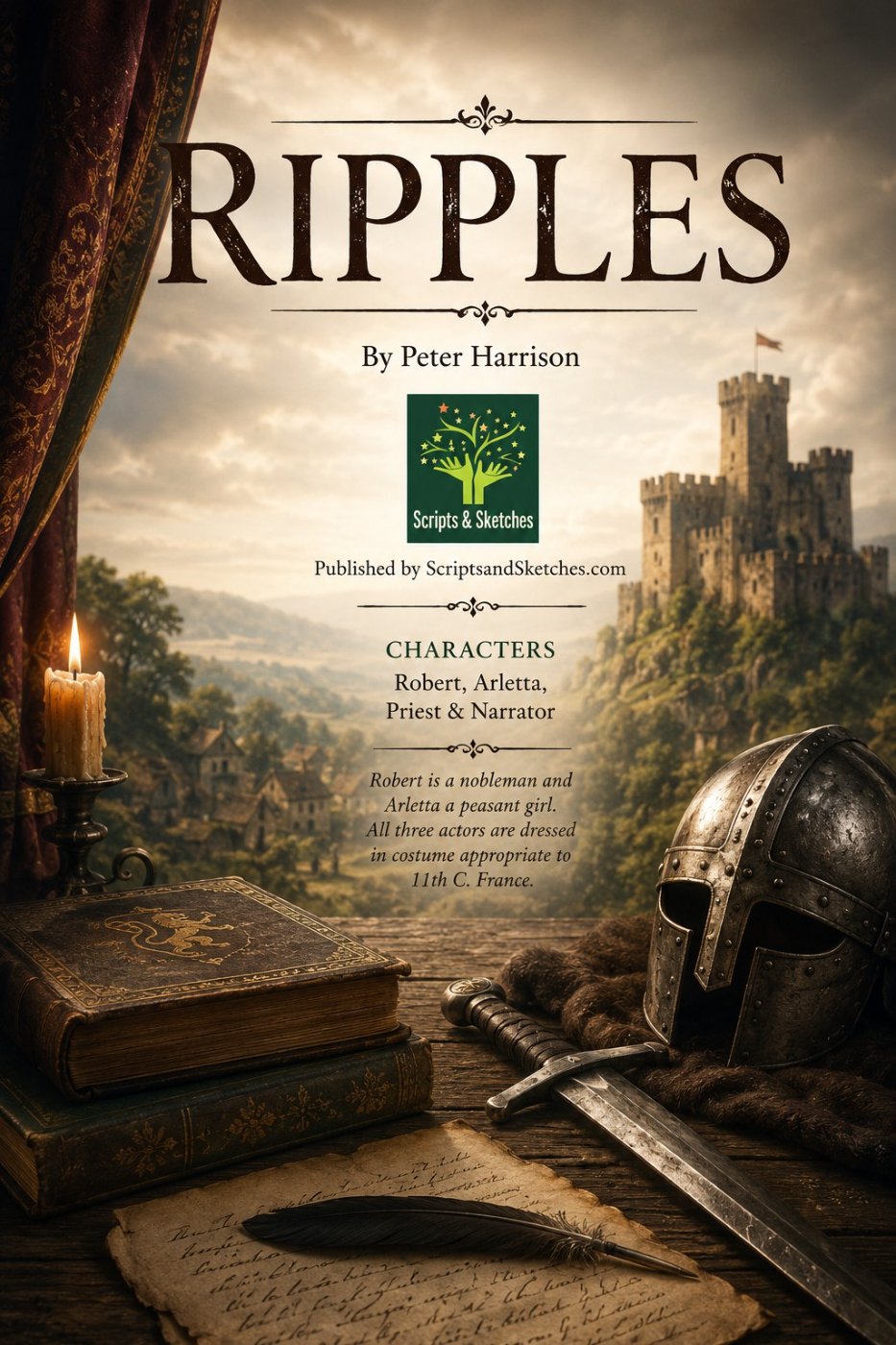
4 cast members · Tragicomedy
Ripples
Ripples · Peter Harrison
1 / 1
Ripples
Published by scriptsandsketches.com

In a tense exchange, Robert, a nobleman, and Arletta, a peasant girl, confront their past and the chasm between their worlds, revealing deep-seated emotions and societal expectations.
Group
Characters: ROBERT, ARLETTA, PRIEST, NARRATOR
The scene is set in 11th Century France, where Robert, a nobleman, and Arletta, a peasant girl, engage in a tense conversation.
ARLETTA:
And you can get trussed. You oaf!
ROBERT:
Welcome. Lady.
ARLETTA:
Did you see?
ROBERT:
I use the term lightly, of course.
ARLETTA:
That man. He laid hands on me. Just now.
ROBERT:
He probably knows how eager I was to see you again.
ARLETTA:
Is that soldier to be punished?
ROBERT:
I think not.
ARLETTA:
Why not?
ROBERT:
He probably remembers that when first I summoned you he was unwise enough to call on you unarmed.
ARLETTA:
Next time he gets a hefty kick in the balls – and chain mail won’t help him. (Robert sighs.)
ROBERT:
I see that your temper has not improved, Arletta.
ARLETTA:
I hope you realise I was busy when your soldiers knocked.
ROBERT:
Woman’s work? It can wait. (Arletta studies him for a moment.)
ARLETTA:
So, now I am here?
ROBERT:
Because I sent for you.
ARLETTA:
Is it now customary, sir, in this age of chivalry, to send for a lady with a sword?
ROBERT:
Do sit down, Arletta.
ARLETTA:
I prefer to stand.
ROBERT:
Well, if you grow tired do feel free to sit.
ARLETTA:
I am not staying. You have taken me away from important work with my father. And I do not care to be summoned by force.
ROBERT:
You did not respond to my first invitation so I had to be more... persuasive. (He regards her appraisingly.)
You are looking well, as always, I’m pleased to say.
You are looking well, as always, I’m pleased to say.
ARLETTA:
I don’t care whether you’re pleased or not. I only know that unlike those who live in castles I have work to do. So I’ll ask you again -- why have you sent for me, sir?
ROBERT:
Please, Arletta, use my name.
ARLETTA:
I shall not. (He sighs.)
ROBERT:
I used to love to hear it on your lips.
ARLETTA:
Well, you will not hear it again. (He sighs, unconvincingly)
ROBERT:
I seem to recall a happier time when your manner was not so cold.
ARLETTA:
I really don’t remember. God’s blood, sir! Are you going to tell me why I was snatched from my duties?
ROBERT:
Presently..... First, tell me what you have been doing? Since we parted.
ARLETTA:
Restoring my spirits.
ROBERT:
Ah....
ARLETTA:
To their former level. (He assumes a hurt look.)
ROBERT:
And are they restored? (Arletta stares back at him implacably.)
Our meetings were pleasant enough surely?
Our meetings were pleasant enough surely?
ARLETTA:
I can’t remember. I only know I am happy again. Or I was until your soldiers came calling.
ROBERT:
Happy to be restored to poverty?
ARLETTA:
Happy to be back where I belong.
ROBERT:
....Are you saying you can’t remember our summer walks together, along the lanes behind the castle? (He smiles.)
And into the woods.
And into the woods.
ARLETTA:
They were lanes leading nowhere, my lord.
ROBERT:
I can’t imagine where you hoped they might lead.
ARLETTA:
And I can’t imagine what I was thinking of. Which is why I decided to turn back.
ROBERT:
Weren’t we happy.... sometimes, you and I?
ARLETTA:
I tell you, I don’t remember.
ROBERT:
Your memory is serving you badly today, Arletta. Surely, at least, you still recall our first meeting with some fondness?
ARLETTA:
No.
ROBERT:
As I do.
ARLETTA:
I remember it. But not with fondness. With shame, perhaps. (He laughs.)
ROBERT:
I don’t believe you.
ARLETTA:
(Fiercely) I’ll tell you what I do remember. I remember that you apparently saw me down below the walls and sent for me. As you would summon a harlot. What an ardent and chivalrous lover you were. You didn’t even bother to come for me yourself. The cheek of it. Ordering that I be brought in by the rear gate.
ROBERT:
That was before I knew your temper.
ARLETTA:
And I also remember that I refused. In front of all those watching men and women. I said that if I came in it would be by the front gate. And I remember that I did. On horseback. As a lady would. These things I do remember. I also cannot now forget the shame which followed that day. Down in the town. To my lasting regret I was beguiled by your rank, my lord.
ROBERT:
(Complacently) Like others before you.
ARLETTA:
Harlots all.
ROBERT:
(Laughing) And do not speak of shame. Where so many are involved it is not shame but custom.
ARLETTA:
Not for me, it isn’t.
ROBERT:
At any rate my mother insists it was you who beguiled me.
ARLETTA:
Your ugly mother.
ROBERT:
Have a care, Arletta.
ARLETTA:
Well, she is. Just ask your father. (Robert sighs patiently)
ROBERT:
For the sake of the sweet times between us I am happy to show forbearance but don’t forget you have now returned to your former life and our stations have been restored.
ARLETTA:
Pouf!
So, are you going to tell me what she said?
So, are you going to tell me what she said?
ROBERT:
Who?
ARLETTA:
Your mother.
ROBERT:
She insists that you saw me and my brother looking down from the battlements on the women at work and so behaved... differently.
ARLETTA:
How clever of her.
ROBERT:
To make me notice you.
ARLETTA:
In the village, sire, we have a saying which your mother might know----
ROBERT:
---- I doubt it. I have heard some of your village sayings.
ARLETTA:
We say it takes one to know one.
ROBERT:
Do you recall what beguiling tricks she might be speaking of? (Arletta sighs wearily.)
ARLETTA:
Sweet Jesus, what is this all about?
ROBERT:
Do you recall why I saw you and none other?
ARLETTA:
I should do.
ROBERT:
Ah. So pleasant recollections are returning?
ARLETTA:
I recall it only because you have bored me to distraction with the telling of it.
ROBERT:
It was because you were laughing.
ARLETTA:
So you keep reminding me. Until I want to scream.
ROBERT:
There you were. Down below the walls working with the other women. Treading the hides in the ditch to soften them. And I will always remember, you were laughing.
ARLETTA:
Would that I had been scowling.
ROBERT:
Women at court do not laugh. Ever. I doubt I had ever seen a woman laugh before. To see you laughing I found ...... irresistible.
ARLETTA:
The women I know laugh all the time. Usually about men.
ROBERT:
But as the days went by you ceased to laugh. And then you were gone. And you never did tell me why.
ARLETTA:
Didn’t I? I’m sure I did. Well, I’ll tell you now. If you care to hear.
ROBERT:
Well? (Arletta sighs wearily.)
ARLETTA:
I was bored, sir.
ROBERT:
I bored you?
ARLETTA:
When the summer nights of sighing were over I discovered there was only silence or noisy misunderstanding between us. I don’t know which was worse.
ROBERT:
What misunderstanding? (She regards him thoughtfully for the first time.)
ARLETTA:
I wonder if you remember, My Lord, the day I tried to talk to you of hunger in the village. Do you remember what you said?
ROBERT:
What did I say?
ARLETTA:
You said it was what you felt after a day’s hunting in the forest....
ROBERT:
Yes? That’s true. So...?
ARLETTA:
I had to explain to you that hunger in my village was continuous. And did not end in feasting.
ROBERT:
Anything else?
ARLETTA:
Let me see. Ah, yes. I happened to remark how cold it could be for many of us in the village if the winter was long and supplies of fuel were exhausted, and you said you had often felt cold. Out hunting. In winter.
ROBERT:
Frozen solid.
ARLETTA:
I told you how fear was always present in our lives in case we transgressed and faced retribution from your father or his soldiers. And.... do you remember what you said?
ROBERT:
Now my memory fails me.
ARLETTA:
You said you often felt fear in the forest when hunting the wild boar.
ROBERT:
Quite true. But still I hunted.
ARLETTA:
Nothing I ever said made any sense to you. I could not face a future spent explaining things. So I left.
ROBERT:
(Sulkily) I seem to remember that much of what you wanted to speak about during those long summer nights I also found tedious.
ARLETTA:
You mean like books?
ROBERT:
Sweet Jesus, why did you always have to be talking about books? Books and reading?
ARLETTA:
Because thanks to the Priest reading had raised me up. (She gestures down to the village.)
To something above the common concerns of life down there.
To something above the common concerns of life down there.
ROBERT:
Like that Greek fellow you were always talking about. I would come back to the castle after a day hunting in the forest to tell you of the boars I had speared and all you could talk about was what you’d been reading.... what was his name?
ARLETTA:
Homer.
ROBERT:
A man turned to dust in his tomb, you tell me, for 20 centuries past. So why bother about him?
ARLETTA:
The Iliad is not dead. Helen of Troy is not dead.
ROBERT:
And who in Hell is Helen of Troy?
ARLETTA:
And The Iliad will still be read when you and I have been dust in the tomb for another 20 centuries.
ROBERT:
Who gives a pox about the Iliad?
ARLETTA:
There are many who care.
ROBERT:
If I want to know something from a book there are clerks in the castle who will read it for me.
ARLETTA:
Have you ever visited the place where the clerks work, my Lord?
ROBERT:
Why should I? They come to me.
ARLETTA:
I would go there often when you were occupied. It is a marvellous place. A place crammed to the rafters with books and parchments. Shakily balanced. Always tottering and falling, in clouds of dust. Some so ancient the clerks hardly dare to turn a page for fear of it crumbling to powder. The Song of Roland, for example. A tale of war and honour. And much killing. You would have enjoyed reading it, my Lord, I’m sure.
ROBERT:
As I told you if I want to read something the clerks will read it for me.
ARLETTA:
Except they never did. You never asked. And so they never did. Is it not strange, sir, that the clerks who have doubtless read many of the books in that great room and filled their minds with the amazing contents live so humbly and obscurely with no one to notice whether they come or go while those like you who do not care to read rule over them?
ROBERT:
Because they’re just words. Lying on a page. Achieving nothing.
ARLETTA:
Words may be stronger than castles, I believe, My Lord.
ROBERT:
That damned priest of yours. Perhaps I should send some soldiers down to talk to him.
ARLETTA:
What about?
ROBERT:
Filling women’s heads with thinking. Including yours.
ARLETTA:
Do not blame the priest, sir, if women are discovered thinking. They can do it without prompting.
ROBERT:
What about our loving then? It appeared you did not find that boring. Down there in the glade in the forest we found for ourselves. (Arletta regards him thoughtfully for a moment.)
ARLETTA:
There are usually many reasons to explain it, my Lord, when a maid repents of her yielding, and those trysts down in the forest helped me find another.
ROBERT:
God’s teeth, Arletta, why must you always talk in riddles?
ARLETTA:
They revealed to me how cruel you were.
ROBERT:
Explain yourself.
ARLETTA:
For generations it has been customary for the young lads of the village to play a rude little game down there in the woods in summer time.
ROBERT:
And I think I know where this is leading.
ARLETTA:
It is a game that all courting lads and maidens know about but it seems are powerless to stop.
ROBERT:
I stopped it.
ARLETTA:
You did, My Lord.
ROBERT:
You refer to the practice of trailing lovers into the woods to observe what they do.
ARLETTA:
As a bunch of feckless lads were foolish enough to trail us to our secret place.
ROBERT:
Foolish indeed.
ARLETTA:
So you set a trap for them when they pursued us to our place one summer night. And as you say you stopped it. With whips and cudgels.
ROBERT:
They had dishonoured me.
ARLETTA:
You may have heard, sir, that one of those cheeky lads is still unconscious from his wounds. So, you see now why it had run its course – this summer tryst?
ROBERT:
What is this all about, Arletta? First you say I bored you. Now it is cruelty you accuse me of. I had no real perception of what a strange maid I had found living down there in the village. Haunting the library. Reading. Writing.... Thinking. Talking day and night. Also, boring me to death. I agree it was an interlude, Arletta. You know our customs. I will marry when my father tells me to and I will marry who he chooses.
ARLETTA:
I don’t give a daft donkey’s droppings who you marry. As long as it isn’t me. You can even try to find a wife who can laugh. And to the devil with your father.
In God’s name, sir! What do you want with me? If you have brought me here, My Lord, to try to rekindle your passion, you would do better to peer down from the walls again and spy another wench who is foolish enough to be laughing. It is over. And forgotten. In future, my gown will remain tightly bound, until an honest suitor comes to call.
In God’s name, sir! What do you want with me? If you have brought me here, My Lord, to try to rekindle your passion, you would do better to peer down from the walls again and spy another wench who is foolish enough to be laughing. It is over. And forgotten. In future, my gown will remain tightly bound, until an honest suitor comes to call.
ROBERT:
Perhaps he has already come?
ARLETTA:
My Lord?
ROBERT:
Come now, Arletta.
ARLETTA:
What?
ROBERT:
Those delightful lies of yours were surely just for lovers. We must talk sensibly now.
There is gossip in the village that you are to be married.
There is gossip in the village that you are to be married.
ARLETTA:
You have been spying on me?
ROBERT:
Not me.
ARLETTA:
Who then?
Oh, let me guess. Your Father?
Oh, let me guess. Your Father?
ROBERT:
I am his future. He watches over it.
ARLETTA:
And so he sends spies to report on me and you allow it. (Arletta regards him steadily for a moment.)
You know, I wonder now that I ever yielded to you.
You know, I wonder now that I ever yielded to you.
ROBERT:
Am I not a handsome fellow? That might be why. (She laughs sarcastically.)
ARLETTA:
It must have been the heat of summer, the birdsong and the moonlight. They stole my wits. Perhaps I should have sought out your father.
ROBERT:
Careful, Madame.
ARLETTA:
My life and what I do now is no concern of you. Or of your father. I hoped I had made that plain. Now may I please leave? (Robert regards her thoughtfully.)
ROBERT:
Nevertheless, is it true? Are you to be married?
ARLETTA:
I will not answer.
ROBERT:
(Mildly) You spoke of fear of the consequences from my father --- how would that delightful body of yours enjoy being flogged, do you suppose, Arletta? Might that not just coax an answer from you? (Arletta looks both defiant and apprehensive...)
I, your Lord, asked you a very civil question. Be good enough to answer it. (.. But quickly recovers her former poise.)
I, your Lord, asked you a very civil question. Be good enough to answer it. (.. But quickly recovers her former poise.)
ARLETTA:
You threaten me, my lord? You would attack and wound this body you kissed and stroked and slobbered over? I see now for certain that your love has finally waned.
ROBERT:
Are you to be married?
ARLETTA:
I am.
ROBERT:
And who is the lucky fellow?
ARLETTA:
I have told you I intend to marry. The rest is of no concern to you now.
ROBERT:
A huntsman, I believe. (Arletta regards him with astonishment.)
One who works for your father. Supplying hides.
One who works for your father. Supplying hides.
ARLETTA:
(Softly) Sweet Jesus, why are you spying on me, Robert? Did I ever really know you? How could a man change so grievously? After all your tender kisses, all your sighs of desire, those summer nights, out there in the grass. For the sake of what we once felt for each other please now let me go. Let me leave and be forgotten.
ROBERT:
(Implacably) Does he know about us?
ARLETTA:
My father?
ROBERT:
Your betrothed.
ARLETTA:
No. (then wildly) Yes.
ROBERT:
Every little thing? (He smiles coldly.)
Every .... little.... thing? There are some secrets, Arletta, that a maid can never hope to keep.
Every .... little.... thing? There are some secrets, Arletta, that a maid can never hope to keep.
ARLETTA:
What do you mean?
ROBERT:
You should not be such a chatterbox.
ARLETTA:
Chatterbox?
ROBERT:
Down there in the bakery. Day following day. Chattering away. So happy. So glad to confide in anyone who will listen. But you really should be more careful who you confide in. Even among women there are some who are not to be trusted.
ARLETTA:
What have you heard? (Robert regards her thoughtfully.)
ROBERT:
What I have heard is that you are with child.
ARLETTA:
Who says so?
ROBERT:
You do. To any woman who’ll listen. I have also heard that you are assuring all you prattle with that you will be delivered of a boy.
ARLETTA:
I don’t care what your spies have told you. This has nothing to do with your father. Or you. It is over between us. So why won’t your family now leave me alone?
ROBERT:
So, is it true?
ARLETTA:
What if it is? It is no concern of yours.
ROBERT:
This huntsman of yours. I presume he knows.
ARLETTA:
(Hotly) Of course he knows. Andre is the father. And Andre wants to marry me. So my honour is safe. (Robert shakes his head regretfully.)
ROBERT:
There was a time, Arletta, when everything you said to me came from your heart and was true. But now........
ARLETTA:
And what is that supposed to mean?
ROBERT:
(Briskly) Well, it is one of those woman’s mysteries. I do not pretend to know the half of it. I do not wish to know even the quarter of it. But having heard about you chattering away among the women in the bake house, and since you were good enough to reveal the date when you expected to be brought to bed, my Father consulted one of the dames of the Court who knows about these things. She consulted me and made certain.... calculations. Secret, womanly calculations. (Arletta regards him with new alarm.)
It seems your huntsman is a noble fellow, Arletta. But also something of a fool.
It seems your huntsman is a noble fellow, Arletta. But also something of a fool.
ARLETTA:
He is no fool. He is my lover.
ROBERT:
Because it seems the child cannot possibly be his.
Having regard to the calendar, that is. So, whose child do you suppose it is, Arletta? Would it now appear you are the village strumpet?
Having regard to the calendar, that is. So, whose child do you suppose it is, Arletta? Would it now appear you are the village strumpet?
ARLETTA:
I have lain with no man but you, My Lord. And yet Andre wishes to marry me. So, you will see it is not necessary for a man to dwell in a castle to show nobility.
ROBERT:
So why did you lie and tell me he was the father?
ARLETTA:
Because that is what he intends to be. Like most true love, I imagine, it came out of the blue. Like summer lightning. Andre worked with my father. I had scarcely noticed him before. But then I did. What he means to me now you, Robert, never could. I did not know it but all the time I was waiting for him. He knows everything. About you. And about the child.
ROBERT:
Ah, ha. We circle the truth, endlessly it seems, but we have arrived at last. A long Pause.
You must not be alarmed, dear, sweet.... and possibly virtuous Arletta. My father does not resist your marriage to your noble, feckless huntsman.
You must not be alarmed, dear, sweet.... and possibly virtuous Arletta. My father does not resist your marriage to your noble, feckless huntsman.
ARLETTA:
Much good it would do him.
ROBERT:
He knows we were happy for a space. He knows that time passes and we change. And so he wishes you well. As do I.
ARLETTA:
So, can I go?
ROBERT:
Not immediately.
ARLETTA:
When then?
ROBERT:
As I say my father and I both wish for you a long and roistering life with your noble and faithful huntsman. But there is one condition. (Arletta listens with growing apprehension.)
ARLETTA:
What condition?
ROBERT:
You will acknowledge that this is my child. (Arletta laughs sardonically.)
ARLETTA:
Do you really suppose that you or your cursed father have power over this. (She gestures at her stomach.)
It is true, my lord. You took no care. As a village lad would take care. But now it is here. (Again, she gestures at her stomach.)
Safe.... and alive.... that much I know. And under my protection.
It is true, my lord. You took no care. As a village lad would take care. But now it is here. (Again, she gestures at her stomach.)
Safe.... and alive.... that much I know. And under my protection.
ROBERT:
You would defy my father, Madame?
ARLETTA:
Here on this belly of mine there is a place you know well. You have kissed and stroked it many times. It is the place which ties me to my mother. And then to her mother. It is the place which binds all women to their mothers. Continuously, back through all the years...even to ancient times. (She laughs mockingly.)
Do you intend, sir, with all your lands, and wealth and your great castle, to try to break this pretty daisy chain?
Do you intend, sir, with all your lands, and wealth and your great castle, to try to break this pretty daisy chain?
ROBERT:
A daisy chain! What nonsense you talk, Arletta. Of course you may keep the child. You may suckle it. Kiss it. Love it. As a mother should.
ARLETTA:
So what is it that you threaten?
ROBERT:
But you will not perform these offices for my child down in that shit-heap village of yours. Your huntsman lover cannot be allowed to raise the child of one born to the nobility. And be regarded as his... father! The idea is... ludicrous. So ludicrous I may decide to have him flogged for insolence.
ARLETTA:
This is between you and me, sir. Even you or your father would not punish an innocent man.
ROBERT:
You will give up my child. Or it will be taken from you.
ARLETTA:
If you try to take my child away from me, my lord, I will find him wherever you hide him. And I will kill him. Pause.
ROBERT:
A loving mother to be sure.
ARLETTA:
So that you will never be sure that your child is safe. (Robert regards her now with apprehension.)
ROBERT:
(Soothingly) The child will receive all the honours due to one of noble birth. Here, in the castle. With all the privileges of rank and power.
ARLETTA:
And the title bastard, sir.
ROBERT:
It is the custom.
ARLETTA:
Not my custom. Andre’s proposal, on the other hand, is honourable.
ROBERT:
If you safely bear my child your honour is assured.
ARLETTA:
Through marriage?
ROBERT:
Possibly. To someone more..... seemly than a huntsman.
ARLETTA:
One thing, sire, I can assure you of – whatever becomes of me this child will never leave my side. Not until it is old enough to......
ROBERT:
.....To what?
ARLETTA:
(Whispering) To fulfil its destiny.
ROBERT:
Its destiny, if indeed it is a male child, is to live and grow to manhood here in the castle of my ancestors...to stay here and help me rule my lands .... to carry on this name and then succeed me when I am dead.. according to ancient tradition. And if you try to defy me in this I will have your parents’ home brought down in dust and rubble. A long Pause.
ARLETTA:
Pray don’t threaten me, sir. I have warned you of the consequence. Pause.
At any rate, what you describe is not this child’s destiny.
At any rate, what you describe is not this child’s destiny.
ROBERT:
What do you know of its destiny?
ARLETTA:
This child will not stay here.
ROBERT:
If not here where?
ARLETTA:
Not in this land.
ROBERT:
Where then?
ARLETTA:
I don’t know.
ROBERT:
Perhaps he will be a friar with a long white beard wandering the land reading Latin and Greek to any who will listen, like his Mother. (She regards him steadily for a moment.)
ARLETTA:
I now have strange and unusual dreams.
ROBERT:
(Uneasily) What sort of dreams?
ARLETTA:
Portents.
ROBERT:
Portents of what?
ARLETTA:
When they first began I went to see a woman of the village. A woman old in years and wisdom. A woman who sees...... visions.... signs.
ROBERT:
God’s teeth, an oracle. In a shit heap like yours. Or perhaps a witch who deserves to be burned for her visions.
ARLETTA:
No witch. Just an old woman wise in the ways of natural things. She has always been consulted by the women of the village to tell if the child they expect will be a boy or a girl.
ROBERT:
And what did this insolent old sow foresee? Foresee for my child?
ARLETTA:
At my request, she laid hands on me here (she gestures at her belly) and foretold that I was indeed carrying a son. A son whose name would resound down the ages for long centuries to come and be told on the lips of men far beyond the borders of this realm until the very ending of time. Pause
ROBERT:
Who do you think you are? To bear a special child?
ARLETTA:
Ordinary women give birth to extraordinary men.
ROBERT:
Like the daughter of a world-famous tanner of leather hides who lives in something of a hovel? God’s Blood Arletta! What destiny can compare to the one I offer --- a great castle and a life of privilege?
ARLETTA:
I have seen something of your life of privilege, My Lord. A child needs to be trained how to think. To reason. Games and feasting and no doubt wenching, in a castle, will not prepare him.
ROBERT:
Prepare him for what, woman? Reading and writing? What did the crone foretell?
ARLETTA:
I tell you I don’t know. Something extraordinary. (Pause, as Arletta regards him thoughtfully, as though considering her next remark.)
As a woman waits for a child many strange thoughts come to her. Would you like to hear of one? (He sighs theatrically.)
As a woman waits for a child many strange thoughts come to her. Would you like to hear of one? (He sighs theatrically.)
ROBERT:
When you talk, Arletta, endlessly, I fear I have no choice.
ARLETTA:
I sought an answer from the clerks in your library but they could not help.
ROBERT:
I could have one or two of them flogged to see if that inspires them. (Arletta shakes her head wearily, declining the offer.)
ARLETTA:
We know from what we see around us that a child may resemble either its father or its mother.
ROBERT:
To my surprise I understand so far.
ARLETTA:
But never both.
ROBERT:
Obviously.
ARLETTA:
Well, what of its mind? How is it decreed which parent the child’s mind will resemble?
ROBERT:
And why should you care?
ARLETTA:
Because sir, at the risk of being hurled into your dungeons, I would prefer this child not to resemble you.
ROBERT:
For reasons you have made clear. So, what is the answer?
ARLETTA:
Since none of the books the clerks looked in could provide an answer I also consulted the priest.
ROBERT:
That poxy priest again. And you told him of this child?
ARLETTA:
I told him I was betrothed and the thought had come to me. As I’m convinced it comes to all women.
ROBERT:
Only women who waste their time thinking.
ARLETTA:
He considered the point to be one of philosophy and therefore not without interest. But he, too, was uncertain of the answer. He said he would give the matter some thought. (Arletta pauses, as though uncertain about continuing.)
You give me your word you will not punish the priest? Pause
You give me your word you will not punish the priest? Pause
ROBERT:
Possibly not.
ARLETTA:
Robert?
ROBERT:
I will not punish the grovelling dog until I have heard from him.
ARLETTA:
What do you mean? (Robert suddenly shouts into the wings, stage-right.)
ROBERT:
Get me the priest!
ARLETTA:
I ask you not to harm him. (Softly) For all we once meant to one another?
ROBERT:
Ah, I see you now choose to remember those happy days?
ARLETTA:
He is a man of God who spoke to me in confidence.
ROBERT:
And now he will share his thoughts with me. (A pause while they wait. The priest enters, stage-right. He is clearly terrified.)
PRIEST:
Sire, you sent for me?
ROBERT:
This woman ... (PRIEST studies Arletta.)
PRIEST:
Ah, Arletta ...
ROBERT:
You spoke with this woman –
PRIEST:
Did I, sire? I must confess I don’t remember.
ROBERT:
Well, remember now or lose your skin.
ARLETTA:
(To the priest) Please father, humour him.
ROBERT:
Yes. Humour me. You spoke with Arletta about women who find themselves with child -
PRIEST:
In general terms, sire, I may have done. I often speak with women in the village who are with child. It is my holy duty –
ROBERT:
- in particular terms, priest. You spoke with Arletta here about the child she carries. (PRIEST looks shocked and confused.)
ARLETTA:
It is true, father. Forgive me for deceiving you. It was my child we were discussing. Pause.
ROBERT:
Our child, madame. Priest, you discussed together whether or not my unborn child’s ways of thinking would resemble mine. Or Arletta’s.
PRIEST:
But in that moment I did not know we were speaking of your child, sire.
ROBERT:
So what is your answer?
PRIEST:
The mind of the unborn child of a great lord would resemble his, sire. In every particular. (ARLETTA sighs regretfully.)
ARLETTA:
(Gently) You are a good man, father, and like all good men you have no gift for lies. Let me refresh your memory. You told me that after some thought and study you had come to the belief that as the father’s part in creating life was brief and the mother’s endured for almost a full year -
PRIEST:
- I confess, sire, I really cannot recall -
ARLETTA:
- and with the unborn child growing safe and wholly confined within her, secure from all spells or charms which might change or harm it –
PRIEST:
- I protest, sire. This is not ... theological.
ARLETTA:
- connected only to her, and to her immortal soul, the probability was that the child’s thinking would resemble the mother’s. Is that not what you told me?
ROBERT:
Answer her!
PRIEST:
Sire, I spoke only of probabilities!
ROBERT:
Get out, you dog. (PRIEST scuttles from the chamber.)
So ... the child will think like you, Arletta? And who will train him in his thinking? This remarkable child. That poxy priest?
So ... the child will think like you, Arletta? And who will train him in his thinking? This remarkable child. That poxy priest?
ARLETTA:
I will train him to think.
ROBERT:
But let me assure you again, you will not do it down there. (He gestures to the window.)
Down there. In that cold, wet and miserable dump. Where nothing of note has ever happened. Or will ever happen. Whatever the witch foretells.
Down there. In that cold, wet and miserable dump. Where nothing of note has ever happened. Or will ever happen. Whatever the witch foretells.
ARLETTA:
You may provide for him, my lord. But I shall care for him. A man may start a hundred babes and remember nothing of it but a woman must finish what men have started and remember them all. This child you made with pleasure down there in the fields last summer I shall now bear in pain. This child which could well be the death of me. You will marry in due time, no doubt. And also have other children. (She strokes her belly.)
But no other women will care for this child. (ARLETTA opens her arms to embrace the castle.)
In this place.
But no other women will care for this child. (ARLETTA opens her arms to embrace the castle.)
In this place.
ROBERT:
You now give me orders, Madame? You do realise I could have you flogged through the gates and down into town for your insolence?
ARLETTA:
A bedding, then a flogging. What a pretty wooer you proved to be, My Lord. A long thoughtful pause.
ROBERT:
It has been most pleasant but we have bandied words too long, Madame. Now I will state to you clearly what is to happen. I fear you forget one small detail. One small point of law. One little rule of precedence. For all of your defiance and your clever, provoking words, and indeed your insolence, including your insults to the noble lady, my mother, it is my family which still rules here in this revered and ancient place, as it has ruled for as long, I believe, as your Homer’s prattle has endured.
Whereas you dwell down there below the castle walls in a stinking dung pit with a name that nobody ever speaks, among those who live without fame, and whose names are forgotten by the world the minute they are gone.
So, Madame, bearing that in mind, you now have two choices. Marry your ardent, sweet and so forgiving lover. But give up the child to me---you will have many more, no doubt, now that you have learned the trick of it.
Or reject his unwise and tactless offer of marriage, and his love, and be brought to bed here in the castle, keep the child and assist me in raising our son according to the style and custom of his rank. The choice is yours. Your lover. Or your son. Freeze All Fade -Up Music: John Dowland, Mr Knight’s Galliard for Lute. (YouTube,) or Celtica- Medieval Drum Dance (YouTube) Fade –down Music NARRATOR (taped): And so, in the month of April, in the year 1027, in the great castle of Falaise in Normandy, Arletta, also known as Herleva, is indeed delivered of a son. The high rank and status of the child’s father ensures that she will never again be able to return to the village where she was born. Arletta cares for the infant in childhood and through his father’s influence eventually marries a knight called Herluin and from this marriage produces two further sons and two daughters. But it is her illegitimate first-born son who succeeds to the title, as William, Duke of Normandy. He grows to manhood and eventually triumphs over the English army of King Harold at the Battle of Hastings in 1066 and is crowned King, known hereafter to the British as William the Conqueror. And thus the brief and turbulent romance between Robert the Magnificent, Duke of Normandy, and Arletta, only daughter of the tanner of Falaise, in the summer fields of Normandy, nearly a thousand years ago, has changed the course of English history for ever. BLACKOUT
Whereas you dwell down there below the castle walls in a stinking dung pit with a name that nobody ever speaks, among those who live without fame, and whose names are forgotten by the world the minute they are gone.
So, Madame, bearing that in mind, you now have two choices. Marry your ardent, sweet and so forgiving lover. But give up the child to me---you will have many more, no doubt, now that you have learned the trick of it.
Or reject his unwise and tactless offer of marriage, and his love, and be brought to bed here in the castle, keep the child and assist me in raising our son according to the style and custom of his rank. The choice is yours. Your lover. Or your son. Freeze All Fade -Up Music: John Dowland, Mr Knight’s Galliard for Lute. (YouTube,) or Celtica- Medieval Drum Dance (YouTube) Fade –down Music NARRATOR (taped): And so, in the month of April, in the year 1027, in the great castle of Falaise in Normandy, Arletta, also known as Herleva, is indeed delivered of a son. The high rank and status of the child’s father ensures that she will never again be able to return to the village where she was born. Arletta cares for the infant in childhood and through his father’s influence eventually marries a knight called Herluin and from this marriage produces two further sons and two daughters. But it is her illegitimate first-born son who succeeds to the title, as William, Duke of Normandy. He grows to manhood and eventually triumphs over the English army of King Harold at the Battle of Hastings in 1066 and is crowned King, known hereafter to the British as William the Conqueror. And thus the brief and turbulent romance between Robert the Magnificent, Duke of Normandy, and Arletta, only daughter of the tanner of Falaise, in the summer fields of Normandy, nearly a thousand years ago, has changed the course of English history for ever. BLACKOUT

