- Empty cart.
- Continue Shopping
An Ideal Husband – Act 1
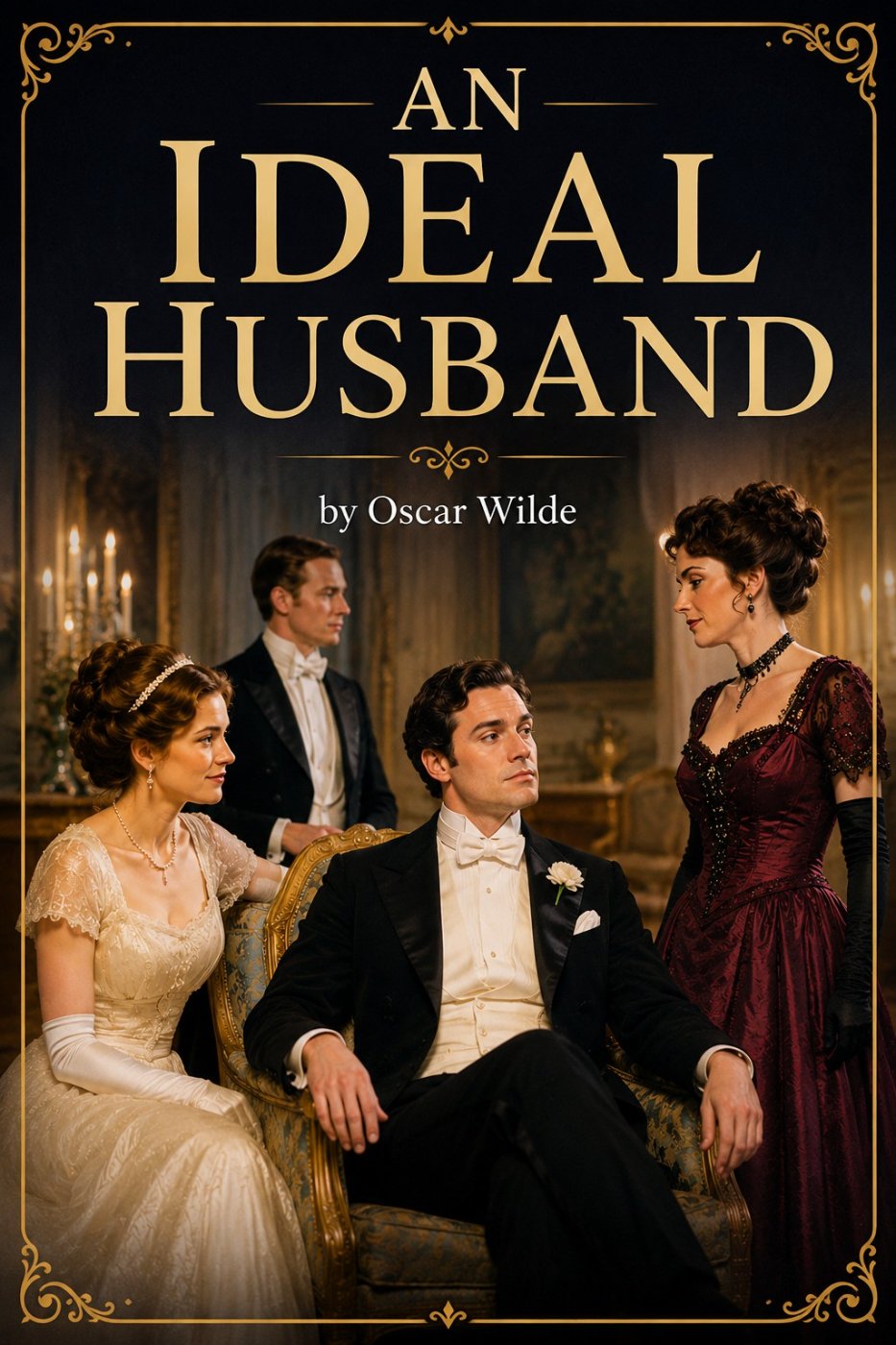
10 cast members · Tragicomedy
An Ideal Husband – Act 1
An Ideal Husband – Act 1 · Oscar Wilde
1 / 1
An Ideal Husband – Act 1
Published by scriptsandsketches.com

In a brilliantly lit octagon room, guests mingle as Lady Chiltern receives them. Conversations reveal the trivialities and complexities of London society, setting the stage for a tale of love and ambition.
Ensemble
Characters: MRS MARCHMONT, LADY BASILDON, MARCHMONT, MASON, CHILTERN, MABEL CHILTERN, CAYERSHAM, CAVERSHAM, LADY MARKBY, LADY CHILTERN, MRS CHEVELEY, NANJAC, DE NANJAC, LORD GORING, LORD CAVERSHAM, MR. MONTFORD, MR MONTFORD
MRS MARCHMONT:
Going on to the Hartlocks' tonight, Margaret?
LADY BASILDON:
I Suppose so. Are you? MRS
MARCHMONT:
Yes. Horribly tedious parties they give, don't they?
LADY BASILDON:
Horribly tedious! Never know why I go. Never know why I go anywhere. MRS
MARCHMONT:
I come here to be educated.
LADY BASILDON:
Ah! I hate being educated! MRS
MARCHMONT:
So do I. It puts one almost on a level with the commercial classes, doesn't it? But dear Gertrude Chiltern is always telling me that I should have some serious purpose in life. So I come here to try to find one.
LADY BASILDON:
(Looking round through her lorgnette) I don't see any body here tonight whom one could possibly call a serious person. The man who took me in to dinner talked to me about his wife the whole time. MRS
MARCHMONT:
How very trivial of him!
LADY BASILDON:
Terribly trivial! What did your man talk about? . MRS
MARCHMONT:
About myself.
LADY BASILDON:
(Languidly). And were you interested? MRS
MARCHMONT:
(Shaking her head). Not in the smallest degree.
LADY BASILDON:
What martyrs we are, dear Margaret! MRS MARCHMONT (Rising) And how well it becomes us, Olivia! (They rise and go towards the music-room. The VICOMTE DE NANJAC, a young attache known for his neckties and his Anglomania, approaches with a low bow, and enters into conversation. )
MASON:
(Announcing guests from the top o f the staircase). Mr. and Lady Jane Barford. Lord Caversham. (Enter LORD CAVERSHAM, an old gentleman of seventy, wearing the riband and star of the Garter. A fine Whig type. Rather like a portrait by Lawrence.) LORD CAYERSHAM Good evening , Lady Chiltern! Has my good-for nothing young son been here? LADY
CHILTERN:
(Smiling). I don't think Lord Goring has arrived yet.
MABEL CHILTERN:
(Coming up to LORD CAVERSHAM). Why do you call Lord Goring good-for-nothing ? (MABEL CHILTERN is a perfect example of the English type of prettiness, the apple-blossom type. She has all the fragrance and freedom of a flower. There is ripple after ripple of sunlight in her hair, and the little mouth, with its parted lips, is expectant, like the mouth of a child. She has the fascinating tyranny of youth, and the astonishing courage of innocence. To sane people she is not reminiscent of any work of art. But she is really like a Tanagra statuette, and would be rather annoyed if she were told so.) LORD
CAYERSHAM:
Because he leads such an idle life.
MABEL CHILTERN:
How can you say such a thing? Why, he rides in the Row at ten o'clock in the morning, goes to the Opera three times a week, changes his clothes at least five times a day, and dines out every night of the season. You don 't call that leading an idle life, do you? LORD
CAYERSHAM:
(Looking at her with a kindly twinkle in his eye) You are a very charming young lady!
MABEL CHILTERN:
How sweet of you to say that, Lord Caversham! Do come to us more often. You know we are always at home on Wednesdays, and you look so well with your star! LORD
CAYERSHAM:
Never go anywhere now. Sick of London Society. Shouldn 't mind being introduced to my own tailor; he always votes on the right side. But object strongly to being sent down to dinner with my wife's milliner. Never could stand Lady Caversham's bonnets.
MABEL CHILTERN:
Oh, I love London Society! I think it has immensely improved. It is entirely composed now of beautiful idiots and brilliant lunatics. Just what Society should be. LORD
CAVERSHAM:
Hmm! Which is Goring? Beautiful idiot, or the other thing?
MABEL CHILTERN:
(Gravely). I have been obliged for the present to put Lord Goring into a class, quite by himself. But he is developing charmingly! LORD
CAVERSHAM:
Into what?
MABEL CHILTERN:
(With a little curtsey). I hope to let you know very soon, Lord Caversham!
MASON:
(Announcing guests ) Lady Markby, Mrs Cheveley. (Enter LADY MARKBY and MRS CHIEVELEY. LADY MARKBY is a pleasant, kindly, popular woman, with grey hair a la marquise and good lace. MRS CHEVELEY, who accompanies her, is tall and rather slight. Lips very thin and highly-coloured, a line of scarlet on a pallid face. Venetian red hair, aquiline nose, and long throat. Rouge accentuates the natural paleness of his complexion. Grey-green eyes that move restlessly. She is in heliotrope, with diamonds. She looks rather like an orchid, and makes great demands on one's curiosity. In all her movements she is extremely graceful. A work of art, on the whole, but showing the influence of too many schools.)
LADY MARKBY:
Good evening, dear Gertrude! So kind of you to let me bring my friend, Mrs Cheveley. Two such charming women should know each other!
LADY CHILTERN:
(Advances toward MRS CHEVELEY with a sweet smile. Then suddenly stops, and bows rather distantly). I think Mrs Cheveley and I have met before. I did not know she had married a second time.
LADY MARKBY:
(Genially). Ah, nowadays people marry as often as they can, don't they? It is most fashionable. (To DUCHESS OF MARYBOROUGH) Dear Duchess, and how is the Duke? Brian still weak, I suppose? Well, that is only to be expected, is it not? His good father was just the same . There is nothing like race , is there?
MRS CHEVELEY:
(Playing with her fan). But have we really met before, Lady Chiltern? I can't remember where. I have been out of England for so long.
LADY CHILTERN:
We were at school together, Mrs Cheveley.
MRS CHEVELEY:
(superciliously) Indeed? I have forgotten all about my school days. I have a vague recollection that they were detestable.
LADY CHILTERN:
(coldly) I am not surprised!
MRS CHEVELEY:
Do you know, I am quite looking forward to meeting your clever husband, Lady Chiltern. Since he has been at the Foreign Office he has been so much talked of in Vienna. They actually succeed in spelling his name right in the newspapers. That in itself is fame, on the continent
LADY CHILTERN:
I hardly think there will be much in common between you and my husband, Mrs Cheveley (moves away) VICOMTE DE
NANJAC:
Ah! Chere Madame, quelle surprise! I have not seen you since Berlin!
MRS CHEVELEY:
Not since Berlin, Vicomte. Five years ago! VICOMTE DE
NANJAC:
And you are younger and more beautiful than ever. How do you manage it?
MRS CHEVELEY:
By making it a rule to only talk to perfectly charming people like yourself. VICOMTE
DE NANJAC:
Ah! You flatter me. You butter me, as the say here.
MRS CHEVELEY:
Do they say that here? How dreadful of them! VICOMTE DE
NANJAC:
Yes, they have a wonderful language. It should be more widely known. (SIR ROBERT CHLITERN enters. A man of forty, but looking somewhat younger. Clean-shaven with finely-cut features, dark-haired and dark-eyed. A personality of mark. Not popular -- few personalities are. But intensely admired by the few, and deeply respected by the many. The note of his manner is that of perfect distinction, with a slight touch of pride. One feels that he is conscious of the success he has made in life. A nervous temperament with a tired look. The firmy-chiselled mouth and chin contrast strikingly with the romantic expression of the deep passion and intellect, as though thought and emotion were each isolated in it’s own sphere through some violence of will-power. There is nervousness in his nostrils, and in the pale, thin, pointed hands. It would be inaccurate to call him picturesque. Picturesqueness cannot survive the House of Commons. But Vandyck would have liked to have painted his head) SIR ROBERT
CHILTERN:
Good evening, Lady Marby! I hope you have bought Sir John with you?
LADY MARKBY:
Oh! I have bought a much more charming person than Sir John. Sir John’s since he has taken seriously to politics has become quite unbearable. Really, now that the House Of Commons is trying to become useful, it does a great deal of harm. SIR ROBERT
CHILTERN:
I hope not, Lady Markby. At any rate we do our best not to waste the public time, don't we? But who is this charming person you have been kind enough to bring to us?
LADY MARKBY:
Her name is Mrs Cheveley. One of the Dorsetshire Cheveleys, I suppose. But I really don't know. Families are so mixed nowadays. Indeed, as a rule, everybody turns out to be somebody else. SIR ROBERT
CHILTERN:
Mrs Cheveley? I seem to know the name.
LADY MARKBY:
She has just arrived from Vienna. SIR ROBERT
CHILTERN:
Ah! yes. I think I know of whom you mean.
LADY MARKBY:
Oh! She goes everywhere there, and has such pleasant scandals about all her friends. I really must go to Vienna next winter. I hope there is a good chef at the Embassy. SIR ROBERT
CHILTERN:
If there is not, the Ambassador will certainly have to be recalled. Pray point out Mrs Cheveley to me. I should like to see her.
LADY MARKBY:
Let me introduce you. (To MRS CHEVELEY) My dear, Sir Robert Chiltern is dying to know you! SIR ROBERT
CHILTERN:
(Bowing). Everyone is dying to know the brilliant Mrs Cheveley. Our attaches at Vienna write to us about nothing else.
MRS CHEVELEY:
Thank you, Sir Robert. An acquaintance that begins with a compliment is sure to develop into a real friendship. It starts in the right manner. And I find that I know Lady Chiltern already. SIR ROBERT
CHILTERN:
Really?
MRS CHEVELEY:
Yes. She has just reminded me that we were at school together. I remember it perfectly now. She always got the good conduct prize. I have a distinct recollection of Lady Chiltern always getting the good conduct prize! SIR ROBERT
CHILTERN:
(Smiling )And what prizes did you get, Mrs Cheveley?
MRS CHEVELEY:
My prizes came a little later on in life. I don't think any of them were for good conduct. I forget! SIR ROBERT
CHILTERN:
I am sure they were for something charming!
MRS CHEVELEY:
I don't know that women are always rewarded for being charming. I think they are usually punished for it! Certainly, more women grow old nowadays through the faithfulness of their admirers than through anything else! At least that is the only way I can account for the terribly haggard look of most of your pretty women in London! SIR ROBERT
CHILTERN:
What an appalling philosophy that sounds! To attempt to classify you, Mrs Cheveley, would be an impertinence. But may I ask, at heart, are you an optimist or a pessimist? Those seem to be the only two fashionable religions left to us nowadays.
MRS CHEVELEY:
Oh, I'm neither. Optimism begins in a broad grin, and Pessimism ends with blue spectacles. Besides, they are both of them merely poses. SIR ROBERT
CHILTERN:
You prefer to be natural?
MRS CHEVELEY:
Sometimes. But it is such a very difficult pose to keep up. SIR ROBERT
CHILTERN:
What would those modern psychological novelists, of whom we hear so much, say to such a theory as that?
MRS CHEVELEY:
Ah! the strength of women comes from the fact that psychology cannot explain us. Men can be analysed, women ... merely adored. SIR ROBERT
CHILTERN:
You think science cannot grapple with the problem of women?
MRS CHEVELEY:
Science can never grapple with the irrational. That is why it has no future before it, in this world. SIR ROBERT
CHILTERN:
And women represent the irrational.
MRS CHEVELEY:
Well-dressed women do. SIR ROBERT
CHILTERN:
(With a polite bow). I fear I could hardly agree with you there. But do sit down. And now tell me, what makes you leave your brilliant Vienna for our gloomy London - or perhaps the question is indiscreet?
MRS CHEVELEY:
Questions are never indiscreet. Answers sometimes are. SIR ROBERT
CHILTERN:
Well, at any rate, may I know if it is politics or pleasure?
MRS CHEVELEY:
Politics are my only pleasure. You see nowadays it is not fashionable to flirt till one is forty, or to be romantic till one is forty-five, so we poor women who are under thirty, or say we are, have nothing open to us but politics or philanthropy. And philanthropy seems to me to have become simply the refuge of people who wish to annoy their fellow-creatures. I prefer politics. I think they are more ... becoming! SIR ROBERT
CHILTERN:
A political life is a noble career!
MRS CHEVELEY:
Sometimes. And sometimes it is a clever game, Sir Robert. And sometimes it is a great nuisance. SIR ROBERT
CHILTERN:
Which do you find it?
MRS CHEVELEY:
I? A combination of all three. (Drops her fan.) SIR ROBERT
CHILTERN:
(Picks up fan). Allow me!
MRS CHEVELEY:
Thank you. SIR ROBERT
CHILTERN:
But you have not told me yet what makes you honour London so suddenly. Our season is almost over.
MRS CHEVELEY:
Oh! I don't care about the London season! It is too matrimonial. People are either hunting for husbands, or hiding from them. I wanted to meet you. It is quite true. You know what a woman's curiosity is .. almost as great as a man's! I wanted immensely to meet you, and ... to ask you to do something for me. SIR ROBERT
CHILTERN:
I hope it is not a little thing, Mrs Cheveley. I find that little things are so very difficult to do.
MRS CHEVELEY:
(After a moment's reflection). No, I don't think it is quite a little thing. SIR ROBERT
CHILTERN:
I am so glad. Do tell me what it is.
MRS CHEVELEY:
Later on. (Rises.) And now may I walk through your beautiful house? I hear your pictures are charming. Poor Baron Arnheim - you remember the Baron?-used to tell me you had some wonderful Corots. SIR ROBERT
CHILTERN:
(With an almost imperceptible start). Did you know Baron Arnheim well?
MRS CHEVELEY:
(Smiling). Intimately.Did you? SIR ROBERT
CHILTERN:
At one time.
MRS CHEVELEY:
Wonderful man, wasn't he? SIR ROBERT CHILTERN (After a pause). He was very remarkable, in many ways.
I often think it such a pity he never wrote his memoirs. They would have been most interesting . SIR ROBERT
I often think it such a pity he never wrote his memoirs. They would have been most interesting . SIR ROBERT
CHILTERN:
Yes, he knew men and cities well, like the old Greek.
MRS CHEVELEY:
Without the dreadful disadvantage of having a Penelope waiting at home for him.
MASON:
Lord Goring. (Enter LORD GORING. Thirty- four, but always says he is younger. A well bred, expressionless face. He is clever, but would not like to be thought so. A flawless dandy, he would be annoyed if he were considered romantic. He plays with life, and is on perfectly good terms with the world. He is fond of being misunderstood. It gives him a post of vantage.) SIR ROBERT
CHILTERN:
Good evening , my dear Arthur! Mrs Cheveley, allow me to introduce to you Lord Goring, the idlest man in London.
MRS CHEVELEY:
I have met Lord Goring before.
LORD GORING:
(Bowing). I did not think you would remember me, Mrs Cheveley.
MRS CHEVELEY:
My memory is under admirable control. And are you still a bachelor?
LORD GORING:
I . . . believe so.
MRS CHEVELEY:
How very romantic!
LORD GORING:
Oh! I am not at all romantic. I am not old enough. I leave romance to my seniors. SIR ROBERT
CHILTERN:
Lord Goring is the result of Boodle's Club, Mrs Cheveley.
MRS CHEVELEY:
He reflects every credit on the institution.
LORD GORING:
May I ask are you staying in London long?
MRS CHEVELEY:
That depend s partly on the weather, partly on the cooking, and partly on Sir Robert. SIR ROBERT
CHILTERN:
You are not going to plunge us into a European war, I hope?
MRS CHEVELEY:
There is no danger, at present! (She nods to LORD GORING, with a look of amusement in her eyes, and goes out with SIR ROBERT CHILTERN. LORD GORING saunters over to MABEL CHILTERN)
MABEL CHILTERN:
You are very late!
LORD GORING:
Have you missed me?
MABEL CHILTERN:
Awfully!
LORD GORING:
Then I am sorry I did not stay away longer. I like being missed.
MABEL CHILTERN:
How very selfish of you!
LORD GORING:
I am very selfish.
MABEL CHILTERN:
You are always telling me of your bad qualities, Lord Goring.
LORD GORING:
I have only told you half of them as yet, Miss Mabel!
MABEL CHILTERN:
Are the others very bad?
LORD GORING:
Quite dreadful! When I think of them at night I go to sleep at once.
MABEL CHILTERN:
Well, I delight in your bad qualities. I wouldn't have you part with one of them.
LORD GORING:
How very nice of you! But then you are always nice. By the way, I want to ask you a question, Miss Mabel. Who brought Mrs Cheveley here? That woman in heliotrope, who has just gone out of the room with your brother?
MABEL CHILTERN:
Oh, I think Lady Markby brought her. Why do you ask?
LORD GORING:
I haven't seen her for years, that is all.
MABEL CHILTERN:
What an absurd reason!
LORD GORING:
All reasons are absurd.
MABEL CHILTERN:
What sort of a woman is she?
LORD GORING:
Oh! A genius in the daytime and a beauty at night!
MABEL CHILTERN:
I dislike her already.
LORD GORING:
That shows your admirable good taste. VICOMTE
DE NANJAC:
(Approaching). Ah, the English young lady is the dragon of good taste, is she not? Quite the dragon of good taste.
LORD GORING:
So the newspapers are always telling us. VICOMTE
DE NANJAC:
I read all your English newspapers, I find them so amusing.
LORD GORING:
Then, my dear Nanjac, you must certainly read between the lines. VICOMTE
DE NANJAC:
I should like to, but my professor objects. (To MABEL CHILTERN.) May I have the pleasure of escorting you to the music-room, Mademoiselle?
MABEL CHILTERN:
(Looking very disappointed). Delighted, Vicomte, quite delighted! (Turning to LORD GORING) Aren't you coming to the music-room?
LORD GORING:
Not if there is any music going on, Miss Mabel!
MABEL CHILTERN:
(Severely). The music is in German. You would not understand it. (Goes out with the VICOMTE DE NANJAC. LORD CAVERSHAM comes up to his son.)
LORD CAVERSHAM:
Well, sir! what are you doing here? Wasting your life as usual! You should be in bed, sir. You keep too late hours! I heard of you the other night at Lady Rufford's dancing till four o'clock in the morning!
LORD GORING:
Only a quarter to four, father.
LORD CAVERSHAM:
Can't make out how you stand London Society. The thing has gone to the dogs, a lot of damned nobodies talking about nothing.
LORD GORING:
I love talking about nothing, father. It is the only thing I know anything about.
LORD CAVERSHAM:
You seem to me to be living entirely for pleasure.
LORD GORING:
What else is there to live for, father? Nothing ages like happiness.
LORD CAVERSHAM:
You are heartless, sir, very heartless!
LORD GORING:
I hope not, father. Good evening, Lady Basildon!
LADY BASILDON:
(Arching two pretty eyebrows). Are you here? I had no idea you ever came to political parties!
LORD GORING:
I adore political parties. They are the only place left to us where people don't talk politics.
LADY BASILDON:
I delight in talking politics. I talk them all day long. But I can't bear listening to them. I don't know how the unfortunate men in the House stand these long debates.
LORD GORING:
By never listening.
LADY BASILDON:
Really?
LORD GORING:
(In his most serious manner). Of course . You see, it is a very dangerous thing to listen. If one listens one may be convinced; and a man who allows himself to be convinced by an argument is a thoroughly unreasonable person.
LADY BASILDON:
Ah! That accounts for so much in men that I have never understood , and so much in women that their husbands never appreciate in them!
MRS MARCHMONT:
(With a sigh ). Our husbands never appreciate anything in us. We have to go to others for that! (emphatically). Yes, always to others, have we not?
LORD GORING:
(Smiling). And those are the views of the two ladies who are known to have the most admirable husbands in London.
MRS MARCHMONT:
That is exactly what we can't stand. My Reginald is quite hopelessly faultless. He is really unendurably so, at times! There is not the smallest element of excitement in knowing him.
LORD GORING:
How terrible! Really, the thing should be more widely known!
LADY BASILDON:
Basildon is quite as bad; he is as domestic as if he were a bachelor.
MRS MARCHMONT:
(Pressing LADY BASILDON's hand). My poor Olivia! We have married perfect husbands, and we are well punished for it.
LORD GORING:
I should have thought it was the husbands who were punished.
MRS MARCHMONT:
(Drawing herself up ). Oh dear, no! They are as happy as possible! And as for trusting us, it is tragic how much they trust us.
LADY BASILDON:
Perfectly tragic!
LORD GORING:
Or comic, Lady Basildon?
LADY BASILDON:
Certainly not comic, Lord Goring. How unkind of you to suggest such a thing!
MRS MARCHMONT:
I am afraid Lord Goring is in the camp of the enemy, as usual. I saw him talking to that Mrs Cheveley when he came in.
LORD GORING:
Handsome woman, Mrs Cheveley!
LADY BASILDON:
(Stiffly). Please don't praise other women in our presence You might wait for us to do that!
LORD GORING:
I could wait.
MRS MARCHMONT:
Well, we are not going to praise her. I hear she went to the Opera on Monday night, and told Tommy Rufford at supper that, as far as she could see, London Society was entirely made up of dowdies and dandies.
LORD GORING:
She is quite right, too. The men are all dowdies and the women are all dandies, aren't they?
MRS MARCHMONT:
(After a pause). Oh! do you really think that is what Mrs Cheveley meant?
LORD GORING:
Of course. And a very sensible remark for Mrs Cheveley to make, too. (Enter MABEL CHILTERN. She joins the group.)
MABEL CHILTERN:
Why are you talking about Mrs Cheveley? Everybody is talking about Mrs Cheveley! Lord Goring says - what did you say, Lord Goring, about Mrs Cheveley? Oh! I remember, that she was a genius in the daytime and a beauty at night.
LADY BASILDON:
What a horrid combination! So very unnatural! MRS MARCHMONT (On her most dreamy manner). I like looking at geniuses, and listening to beautiful people.
LORD GORING:
Ah! that is morbid of you, Mrs Marchmont!
MRS MARCHMONT:
(Brightening to a look of real pleasure). I am so glad to hear you say that. Marchmont and I have been married for seven years, and he has never once told me that I was morbid. Men are sopainfully unobservant!
LADY BASILDON:
(Turning to her). I have always said, dear Margaret, that you were the most morbid person in London.
MRS MARCHMONT:
Ah! but you are always sympathetic, Olivia!
MABEL CHILTERN:
Is it morbid to have a desire for food? I have a great desire for food. Lord Goring, will you give me some supper?
LORD GORING:
With pleasure, Miss Mabel. (Moves away with her.)
MABEL CHILTERN:
How horrid you have been! You have never talked to me the whole evening!
LORD GORING:
How could I? You went away with the child diplomatist.
MABEL CHILTERN:
You might have followed us. Pursuit would have been only polite. I don't think I like you at all this evening!
LORD GORING:
I like you immensely.
MABEL CHILTERN:
Well, I wish you'd show it in a more marked way! (They go downstairs.)
MRS MARCHMONT:
Olivia, I have a curious feeling of absolute faintness. I think I should like some supper very much. I know I should like some supper.
LADY BASILDON:
I am positively dying for supper, Margaret!
MRS MARCHMONT:
Men are so horribly selfish, they never think of these things.
LADY BASILDON:
Men are grossly material, grossly material! (VICOMTE DE NANJAC enters from the music-room with some other guests. After having carefully examined all the people present, he approaches LADY BASILDON) VICOMTE
DE NANJAC:
May I have the honour of taking you down to supper, Comtesse?
LADY BASILDON:
(Coldly). I never take supper, thank you, Vicomte. (The VICOMTE is about to retire. LADY BASILDON, seeing this, rises at once and takes his arm.) But I will come down with you with pleasure. VICOMTE
DE NANJAC:
I am so fond of eating! I am very English in all my tastes.
LADY BASILDON:
You look quite English, Vicomte, quite English. (They pass out, MR MONTFORD, a perfectly groomed young dandy, approaches MRS MARCHMONT.)
MR. MONTFORD:
Like some supper, Mrs Marchmont? MRS MARCHMONT (Languidly). Thank you, Mr. Montford, I never touch supper. (Rises hastily and takes his arm.) But I will sit beside you, and watch you.
MR MONTFORD:
I don't know that I like being watched when I am eating!
MRS MARCHMONT:
Then I will watch someone else.
MR MONTFORD:
I don't know that I should like that either.
MRS MARCHMONT:
(Severely). Pray, Mr. Montford, do not make these painful scenes of jealousy in public! (They go downstairs with the other guests, passing SIR ROBERT CHILTERN and MRS CHEVELEY, who now enter.) SIR ROBERT
CHILTERN:
And are you going to any of our country houses before you leave England, Mrs Cheveley?
MRS CHEVELEY:
Oh, no! I can't stand your English house-parties. In England people actually try to be brilliant at breakfast. That is so dreadful of them! Only dull people are brilliant at breakfast. And then the family skeleton is always reading family prayers. My stay in England really depends on you, Sir Robert. (Sits down on the sofa.) SIR ROBERT
CHILTERN:
(Taking a seat beside her). Seriously?
MRS CHEVELEY:
Quite seriously. I want to talk to you about a great political and financial scheme, about this Argentine Canal Company, in fact. SIR ROBERT
CHILTERN:
What a tedious, practical subject for you to talk about, Mrs Cheveley!
MRS CHEVELEY:
Oh, I like tedious, practical subjects. What I don't like are tedious, practical people. There is a wide difference. Besides, you are interested, I know, in International Canal schemes. You were Lord Radley's secretary, weren't you, when the Government bought the Suez Canal shares? SIR ROBERT
CHILTERN:
Yes. But the Suez Canal was a very great and splendid undertaking. It gave us our direct route to India. It had imperial value. It was necessary that we should have control. This Argentine scheme is a commonplace Stock Exchange swindle.
MRS CHEVELEY:
A speculation, Sir Robert! A brilliant, daring speculation. SIR ROBERT
CHILTERN:
Believe me, Mrs Cheveley, it is a swindle. Let us call things by their proper names. It makes matters simpler. We have all the information about it at the Foreign Office. In fact, I sent out a special Commission to inquire into the matter privately, and they report that the works are hardly begun, and as for the money already subscribed, no one seems to know what has become of it. The whole thing is a second Panama, and with not a quarter of the chance of success that miserable affair ever had. I hope you have not invested in it. I am sure you are far too clever to have done that.
MRS CHEVELEY:
I have invested very largely in it. SIR ROBERT
CHILTERN:
Who could have advised you to do such a foolish thing? ·
MRS CHEVELEY:
Your old friend - and mine. SIR ROBERT
CHILTERN:
Who?
MRS CHEVELEY:
Baron Arnheim. SIR ROBERT
CHILTERN:
(Frowning). Ah! yes. I remember hearing, at the time·of his death, that he had been mixed up in the whole affair.
MRS CHEVELEY:
It was his last romance. His last but one, to do him justice. SIR ROBERT
CHILTERN:
(Rising). But you have not seen my Corots yet. They are in the music-room. Corots seem to go with music, don't they? May I show them to you?
MRS CHEVELEY:
(Shaking her head). I am not in a mood tonight for silver twilights, or rose-pink dawns. I want to talk business. (Motions to him with her fan to sit down again beside her.) SIR ROBERT
CHILTERN:
I fear I have no advice to give you, Mrs Cheveley, except to interest yourself in something less dangerous. The success of the Canal depends, of course, on the attitude of England, and I am going to lay the report of the Commissioners before the House tomorrow night.
MRS CHEVELEY:
That you must not do. In your own interests, Sir Robert, to say nothing of mine, you must not do that. SIR ROBERT
CHILTERN:
(Looking at her in wonder). In my own interests? My dear Mrs Cheveley, what do you mean? (Sits down beside her.)
MRS CHEVELEY:
Sir Robert, I will be quite frank with you. I want you to withdraw the report that you had intended to lay before the House, on the ground that you have reasons to believe that the Commissioners have been prejudiced or misinformed, or something. Then I want you to say a few words to the effect that the Government is going to reconsider the question, and that you have reason to believe that the Canal, if completed, will be of great international value. You know the sort of things ministers say in cases of this kind. A few ordinary platitudes will do. In modern life nothing produces such an effect as a good platitude. It makes the whole world kin. Will you do that for me? SIR ROBERT
CHILTERN:
Mrs Cheveley, you cannot be serious in making me such a proposition!
MRS CHEVELEY:
I am quite serious. SIR ROBERT
CHILTERN:
(Coldly). Pray allow me to believe that you are not.
MRS CHEVELEY:
(Speaking with great deliberation and emphasis). Ah! but I am. And if you do what I ask you, I ... will pay you very hand- somely! SIR ROBERT
CHILTERN:
. Pay me!
MRS CHEVELEY:
Yes. SIR ROBERT
CHILTERN:
I am afraid I don't understand what you mean.
MRS CHEVELEY:
(Leaning back on the sofa and looking at him). How very disappointing! And I have come all the way from Vienna in order that you should thoroughly understand me. SIR ROBERT
CHILTERN:
I fear I don't.
MRS CHEVELEY:
(In her most nonchalant manner). My dear Sir Robert, you are a man of the world, and you have your price, I suppose. Everybody has nowadays. The drawback is that most people are so dreadfully expensive. I know I am. I hope you will be more reasonable in your terms. SIR ROBERT
CHILTERN:
(Rises indignantly). If you will allow me, I will call your carriage for you. You have lived so long abroad, Mrs Cheveley, that you seem to be unable to realize that you are talking to an English gentleman.
MRS CHEVELEY:
(Detains him by touching his arm with her fan, and keeping it there while she is talking). I realize that I am talking to a man who laid the foundation of his fortune by selling to a Stock Exchange speculator, a Cabinet secret. SIR ROBERT
CHILTERN:
(Biting his lip). What do you mean?
MRS CHEVELEY:
(Rising and facing him). I mean that I know the real origin of your wealth and your career, and I have got your letter, too. SIR ROBERT
CHILTERN:
What letter?
MRS CHEVELEY:
(Contemptuously). The letter you wrote to Baron Arnheim, when you were Lord Radley's secretary, telling the Baron to buy Suez Canal shares - a letter written three days before the Government announced its own purchase. SIR ROBERT
CHILTERN:
(Hoarsely). It is not true. MRS CHEVELEY You thought that letter had been destroyed. How foolish of you! It is in my possession. SIR ROBERT
. The affair to which you allude was no more than a speculation. The House of Commons had not yet passed the bill; it might have been rejected.
. The affair to which you allude was no more than a speculation. The House of Commons had not yet passed the bill; it might have been rejected.
MRS CHEVELEY:
It was a swindle, Sir Robert. Let us call things by their proper names. It makes everything simpler. And now I am going to sell you that letter, and the price I ask for it is your public support of the Argentine scheme. You made your own fortune out of one canal. You must help me and my friends to make our fortunes out of another! SIR ROBERT
CHILTERN:
It is infamous, what you propose - infamous!
MRS CHEVELEY:
Oh, no! This is the game of life as we all have to play it, Sir Robert, sooner or later! SIR ROBERT
CHILTERN:
I cannot do what you ask me.
MRS CHEVELEY:
You mean you cannot help doing it. You know you are standing on the edge of a precipice. And it is not for you to make terms. It is for you to accept them. Supposing you refuse - SIR ROBERT
CHILTERN:
What then?
MRS CHEVELEY:
My dear Sir Robert, what then? You are ruined, that is all! Remember to what a point your Puritanism in England has brought you. In the old days nobody pretended to be a bit better than his neighbours. In fact, to be a bit better than one's neighbour was considered excessively vulgar and middle-class. Nowadays, with our modern mania for morality, everyone has to pose as a paragon of purity, incorruptibility, and all the other seven deadly virtues - and what is the result? You all go over like ninepins - one after the other. Not a year passes in England without somebody disappearing. Scandals used to lend charm, or at least interest, to a man - now they crush him. And yours is a very nasty scandal. You couldn't survive it. If it were known that as a young man, secretary to a great and important minister, you sold a Cabinet secret for a large sum of money, and that that was the origin of your wealth and career, you would be hounded out of public life, you would disappear completely. And after all, Sir Robert, why should you sacrifice your entire future rather than deal diplomatically with your enemy. For the moment I am your enemy. I admit it! And I am much stronger than you are. The big battalions are on my side. You have a splendid position, but it is your splendid position that makes you so honorable. You can't defend it! And I am in attack. Of course I have not talked morality to you. You must admit in fairness that I have spared you that. Years ago you did a clever, unscrupulous thing; it turned out to be a great success. You owe to it your fortune and position. And now you have got to pay for it. Sooner or later we have all to pay for what we do. You have to pay now. Before I leave you tonight, you have got to promise me to suppress your report, and to speak in the House in favour of this scheme. SIR ROBERT
CHILTERN:
What you ask is impossible.
MRS CHEVELEY:
You must make it possible. You are going to make it possible. Sir Robert, you know what your English newspapers are like. Suppose that when I leave this house I drive down to some newspaper office, and give them this scandal and the proofs of it! Think of their loathsome joy, of the delight they would have in dragging you down, of the mud and mire there would plunge you in. Think of the hypocrite with his greasy smile penning his leading article, and arranging the foulness of the public placard. SIR ROBERT
CHILTERN:
Stop! You want me to withdraw the report and to make a short speech stating that I believe there are possibilities in the scheme?
MRS CHEVELEY:
(Sitting down on the sofa). Those are my terms. SIR ROBERT
CHILTERN:
(In a low voice). I will give you any sum of money you want.
MRS CHEVELEY:
Even you are not rich enough, Sir Robert, to buy back your past. No man is. SIR ROBERT
CHILTERN:
I will not do what you ask me. I will not.
MRS CHEVELEY:
You have to. If you don't ... (Rises from the sofa.) SIR ROBERT
CHILTERN:
(Bewildered and unnerved). Wait a moment! What did you propose? You said that you would give me back my letter, didn 't you?
MRS CHEVELEY:
Yes. That is agreed. I will be in the Ladies' Gallery tomorrow night at half-past eleven. If by that time - and you will have had heaps of opportunity - you have made an announcement to the House in the terms I wish, I shall hand you back your letter with the prettiest thanks, and the best, or at any rate the most suitable, compliment I can think of. I intend to play quite fairly with you. One should always play fairly ... when one has the winning cards. The Baron taught me that amongst other things. SIR ROBERT
CHILTERN:
You must let me have time to consider your proposal.
MRS CHEVELEY:
No; you must settle now! SIR ROBERT
CHILTERN:
Give me a week - three days!
MRS CHEVELEY:
Impossible! I have got to telegraph to Vienna tonight. SIR ROBERT
CHILTERN:
My God! What brought you into my life?
MRS CHEVELEY:
Circumstances. (Moves towards the door.) SIR ROBERT
CHILTERN:
Don't go. I consent. The report shall be withdrawn . I will arrange for a question to be put to me on the subject.
MRS CHEVELEY:
Thank you. I knew we should come to an amicable agreement. I understood your nature from the first. I analysed you, though you did not adore me. And now you can get my carriage for me, Sir Robert. I see the people coming up from supper, and English men always get romantic after a meal, and that bores me dreadfully. (Exit SIR ROBERT CHILTERN.) [Enter guests, LADY CHILTERN, LADY MARKBY, LORD CAVERSHAM, LADY BASILDON, MRS MARCHMONT, VICOMTE DE NANJAC, MR. MONTFORD.)
LADY MARKBY:
Well, dear Mrs Cheveley, I hope you have enjoyed yourself. Sir Robert is very entertaining, is he not?
MRS CHEVELEY:
Most entertaining! I have enjoyed my talk with him immensely·
LADY MARKBY:
He has had a very interesting and brilliant career. And he has married a most admirable wife. Lady Chiltern is a woman of the very highest principles, I am glad to say. I am a little too old now, myself, to trouble about setting a good example, but I always admire people who do. And Lady Chiltern has a very ennobling effect on life, though her dinner-parties are rather dull sometimes. But one can't have everything, can one? And now I must go, dear. Shall I call for you tomorrow?
MRS CHEVELEY:
Thanks.
LADY MARKBY:
We might drive in the Park at five. Everything looks so fresh in the Park now!
MRS CHEVELEY:
Except the people!
LADY MARKBY:
Perhaps the people are a little jaded. I have often said that the Season as it goes on produces a kind of softening of the brain. However, I think anything is better than high intellectual pressure. That is the most unbecoming thing there is. It makes the noses of the young girls so particularly large. And there is nothing so difficult to marry as a large nose; men don't like them. Good night, dear! (To LADY CHILTERN.) Good night, Gertrude ! (Goes out on LORD CAVERSHAM's arm.)
MRS CHEVELEY:
What a charming house you have Lady Chiltern! I have spent a delightful evening. It has been so interesting getting to know your husband.
LADY CHILTERN:
Why did you wish to meet my husband, Mrs Cheveley?
MRS CHEVELEY:
Oh, I will tell you. I wanted to interest him in this Argentine Canal scheme, of which I dare say you have heard of. And I found him most susceptible - susceptible to reason I mean. A rare thing in a man. I converted him in ten minutes. He is going to make a speech in the House tomorrow night in favour of the idea. We must go to the Ladies Gallery and hear him ! It will be a great occasion!
LADY CHILTERN:
There must be some mistake. That scheme could never have my husband 's support.
MRS CHEVELEY:
Oh, I assure you it's all settled. I don't regret my tedious journey from Vienna now. It has been a great success. But of course, for the next twenty-four hours the whole thing is a dead secret.
LADY CHILTERN:
(Gently). A secret? Between whom?
MRS CHEVELEY:
(With a flash of amusement in her eyes). Between your husband and myself. SIR ROBERT
CHILTERN:
(Entering) Your carriage is here, Mrs Cheveley!
MRS CHEVELEY:
Thanks! Good evening, Lady Chiltern! Good night, Lord Goring! I am at Claridge's. Don't you think you might leave a card?
LORD GORING:
If you wish, Mrs Cheveley!
MRS CHEVELEY:
Oh, don't be so solemn about it, or I shall be obliged to leave a card on you. In England I suppose that would hardly be considered en-gréle. Abroad, we are more civilized. Will you see me down, Sir Robert? Now that we have both the same interests at heart we shall be great friends, I hope! (Sails out on SIR ROBERT CHILTERN 's arm. LADY CHILTERN goes to the top of the staircase and looks down at them as they descend. Her expression is troubled. After a little time she is joined by some of the guests, and passes with them into another reception- room)
MABEL CHILTERN:
What a horrid woman!
LORD GORING:
You should go to bed, Miss Mabel.
MABEL CHILTERN:
Lord Goring!
LORD GORING:
My father told me to go to bed an hour ago. I don't see why I shouldn't give you the same advice. I always pass on good advice. It is the only thing to do with it. It is never of any use to oneself.
MABEL CHILTERN:
Lord Goring, you are always ordering me out of the room. I think it most courageous of you. Especially as I am not going to bed for hours. [Goes over to the sofa] You can come and sit down if you like, and talk about anything in the world, except the Royal Academy, Mrs Cheveley, or novels in the Scotch dialect. They are not improving subjects. (Catches sight of something that is lying on the sofa half hidden by the cushion.) What is this? Someone has dropped a diamond broach! Quite beautiful, isn't it? (Shows it to him.) I wish it was mine, but Gertrude won't let me wear anything but pearls, and I am thoroughly sick of pearls. They make one look so plain, so good, and so intellectual. I wonder whom the brooch belongs to.
LORD GORING:
I wonder who dropped it.
MABEL CHILTERN:
It is a beautiful broach.
LORD GORING:
It is a handsome bracelet.
MABEL CHILTERN:
It isn't a bracelet. It's a broach.
LORD GORING:
It can be used as a bracelet. (Takes it from her, and, pulling out a green letter-case, puts the ornament care full y in it, and replaces the whole thing in his breast-pocket with the most perfect sangfroid.)
MABEL CHILTERN:
What are you doing?
LORD GORING:
Miss Mabel, I am going to make a rather strange request to you.
MABEL CHILTERN:
(Eagerly). Oh, pray do! I have been waiting for it all the evening.
LORD GORING:
(Is a little taken aback, but recovers himself). Don't mention to anybody that I have taken charge of this broach. Should anyone write and claim it, let me know at once.
MABEL CHILTERN:
That is a strange request.
LORD GORING:
Well, you see I gave this brooch to somebody once, years ago.
MABEL CHILTERN:
You did?
LORD GORING:
Yes. (LADY CHILTERN enters alone. The other guests have gone.)
MABEL CHILTERN:
Then I shall certainly bid you good night. Good night, Gertrude! (Exits)
LADY CHILTERN:
Good night, dear! (To LORD GORING) You saw whom Lady Markby brought here tonight?
LORD GORING:
Yes. It was an unpleasant surprise. What did she come here for?
LADY CHILTERN:
Apparently to try and lure Robert to uphold some fraudulent scheme in which she is interested. The Argentine Canal, in fact.
LORD GORING:
She has mistaken her man hasn't she?
LADY CHILTERN:
She is incapable of understanding an upright nature like my husband's!
LORD GORING:
Yes. I should fancy she came to grief if she tried to get Robert into her toils. It is extraordinary what astounding mistakes clever women make.
LADY CHILTERN:
I don't call women of that kind clever. I call them stupid!
LORD GORING:
Same thing often . Good night, Lady Chiltern!
LADY CHILTERN:
Good night! (Enter SIR ROBERT CHILTERN.) SIR ROBERT
CHILTERN:
. My dear Arthur, you are not going? Do stop a little!
LORD GORING:
Afraid I can't, thanks. I have promised to look in at the Hartlocks'. I believe they have got a new Hungarian band that plays mauve Hungarian music. See you soon Good-bye! (Exits) SIR ROBERT
CHILTERN:
How beautiful you look tonight, Gertrude!
LADY CHILTERN:
Robert, it is not true, is it? You are not going to lend your support to this Argentine speculation? You couldn't! SIR ROBERT
CHILTERN:
(Starting). Who told you I intended to do so?
LADY CHILTERN:
That woman who has just gone out, Mrs Cheveley, as she calls herself now. She seemed to taunt me with it. Robert, I know this woman. You don't. We were at school together. She was untruthful, dishonest, an evil influence on everyone whose trust or friendship she could win. I hated her, I despised her. She stole things, she was a thief. She was sent away for being a thief. Why do you let her influence you? SIR ROBERT
CHILTERN:
. Gertrude, what you tell me may be true, but it happened many years ago. It is best forgotten! Mrs Cheveley may have changed since then. No one should be entirely judged by their past. LADY CHILTERN (Sadly). One's past is what one is. It is the only way by which people should be judged. SIR ROBERT
That is a hard saying, Gertrude!
That is a hard saying, Gertrude!
LADY CHILTERN:
It is a true saying, Robert. And what did she mean by boasting that she had got you to lend your support, your name, to a thing I have heard you describe as the most dishonest and fraudulent scheme there has ever been in political life? SIR ROBERT
CHILTERN:
(Biting his lip). I was mistaken in the view I took. We all may make mistakes.
LADY CHILTERN:
But you told me yesterday that you had received the report from the Commission, and that it entirely condemned the whole thing . SIR ROBERT
CHILTERN:
(Walking up and down). I have reasons now to believe that the Commission was prejudiced, or, at any rate, misinformed. Besides, Gertrude, public and private life are different things. They have different laws, and move on different lines.
LADY CHILTERN:
They should both represent man at his highest. I see no difference between them. SIR ROBERT
CHILTERN:
(Stopping). In the present case, on a matter of practical politics, I have changed my mind. That is all.
LADY CHILTERN:
All! SIR ROBERT
CHILTERN:
(Sternly). Yes!
LADY CHILTERN:
Robert! Oh! it is horrible that I should have to ask you such a question - Robert, are you telling me the whole truth? SIR ROBERT
CHILTERN:
Why do you ask me such a question?
LADY CHILTERN:
(After a pause). Why do you not answer it? SIR ROBERT
CHILTERN:
(Sitting down) Gertrude, truth is a very complex thing, and politics is a very complex business. There are wheels within wheels. One may be under .. certain obligations to people that one must pay. Sooner or later in political life one has to compromise. Everyone does.
LADY CHILTERN:
Compromise? Robert, why do you talk so differently tonight from the way I have always heard you talk? Why are you changed? SIR ROBERT
CHILTERN:
I am not changed. But circumstances alter things.
LADY CHILTERN:
Circumstances should never alter principles! SIR ROBERT
CHILTERN:
But if I told you -
LADY CHILTERN:
What? SIR ROBERT
CHILTERN:
That it was necessary, vitally necessary?
LADY CHILTERN:
It can never be necessary to do what is not honourable. Or if it be necessary, then what is it that I have loved! But it is not, Robert; tell me it is not. Why should it be? What gain would you get? Money? We have no need of that! And money that comes from a tainted source is a degradation. Power? But power is nothing in itself. If it is power to do good that is fine - that, and that only. What is it, then? Robert, tell me why you are going to do this dishonourable thing! SIR ROBERT
CHILTERN:
Gertrude, you have no right to use that word. I told you it was a question of rational compromise. It is no more than that.
LADY CHILTERN:
Robert, that is all very well for other men, for men who treat life simply as a sordid speculation; but not for you, Robert, not for you. You are different. All your life you have stood apart from others. You have never let the world soil you. To the world, as to myself, you have been an idol always. Oh! be that idol still. That great inheritance throw not away that tower of ivory, do not destroy. Robert, men can love what is beneath them - things unworthy, stained, dishonoured. We women worship when we love; and when we lose our worship, we lose everything. Oh! don't kill my love for you, don't kill that! SIR ROBERT
CHILTERN:
Gertrude!
LADY CHILTERN:
I know that there are men with horrible secrets in their lives - men who have done some shameful thing, and who in some critical moment, have to pay for it. By doing some other act of shame - oh! don't tell me you are such as they are! Robert, is there in your life any secret dishonour or disgrace. Tell me, tell me at once, that - SIR ROBERT
CHILTERN:
. That what?
LADY CHILTERN:
(Speaking very slowly). That our lives may drift apart. SIR ROBERT
CHILTERN:
Drift apart ?
LADY CHILTERN:
That they may be entirely separate. It would be better for us both. SIR ROBERT
CHILTERN:
Gertrude, there is nothing in my past life that you might not know.
LADY CHILTERN:
I was sure of it, Robert, I was sure of it. But why did you say those dreadful things, things so unlike your real self? Don't let us ever talk about the subject again. You will write, won't you, to Mrs Cheveley, and tell her that you cannot support this scandalous scheme of hers? If you have given her any promise you must take it back, that is all! SIR ROBERT
CHILTERN:
Must I write and tell her that?
LADY CHILTERN:
Surely, Robert! What else is there to do? SIR ROBERT
CHILTERN:
I might see her personally. It would be better.
LADY CHILTERN:
You must never see her again, Robert. She is not a woman you should ever speak to. She is not worthy to talk to a man like you. No, you must write to her at once, now, this moment, and let your letter show her that your decision is quite irrevocable ! SIR ROBERT
CHILTERN:
Write this moment!
LADY CHILTERN:
Yes. SIR ROBERT
CHILTERN:
But it is so late. It is close on twelve.
LADY CHILTERN:
That makes no matter. She must know at once that she has been mistaken in you - and that you are not a man to do anything base or underhand or dishonourable. Write here, Robert. Write that you decline to support this scheme of hers, as you hold it to be a dishonest scheme yes- write the word dishonest. She knows what that word means. (SIR ROBERT CHILTERN sits down and writes a letter. His wife takes it up and reads it.) Yes; that will do. (Rings bell.) And now the envelope. (He writes the envelope slowly . Enter MASON.) Have this letter sent at once to Claridge's Hotel. There is no answer. (Exit MASON. LADY CHILTERN kneels down beside her husband and puts her arms around him) Robert, love gives one an instinct to things. I feel tonight that I have saved you from something that might have been a danger to you, from something that might have made men honour you less than they do. I don't think you realize sufficiently, Robert, that you have brought into the political life of our time a nobler atmosphere, a finer attitude towards life, a freer air of purer aims and higher ideals - I know it, and for that I love you, Robert. SIR ROBERT
CHILTERN:
Oh, love me always, Gertrude, love me always!
LADY CHILTERN:
I will love you always, because you will always be worthy of love. We needs must love the highest when we see it! (Kisses him and rises and goes out.) (SIR ROBERT CHILTERN walks up and down for a moment; then sits down and buries his face in his hands. The Servant enters and begins putting out the lights. SIR ROBERT CHILTERN looks up) SIR ROBERT
CHILTERN:
Put out the lights, Mason, put out the lights! (The Servant puts out the lights. The room becomes almost dark . The only light there is comes from the great chandelier that hangs over the staircase and illumines the tapestry of the Triumph of Love.) ACT DROP

